When there is no NODE ID in the package, the register NODE_FREE_EN related with the packet format
is set to 1, which means that the register NODE_VALUE is not used to define NODE ID, but define a code
value according to a different NODE_SIZE. As long as the receiver detects the data that meets the code value,
a NODE_OK interrupt is generated. Therefore, condition 9 and condition 10 can also be satisfied.
2.4.5 SLP Pattern 11-13
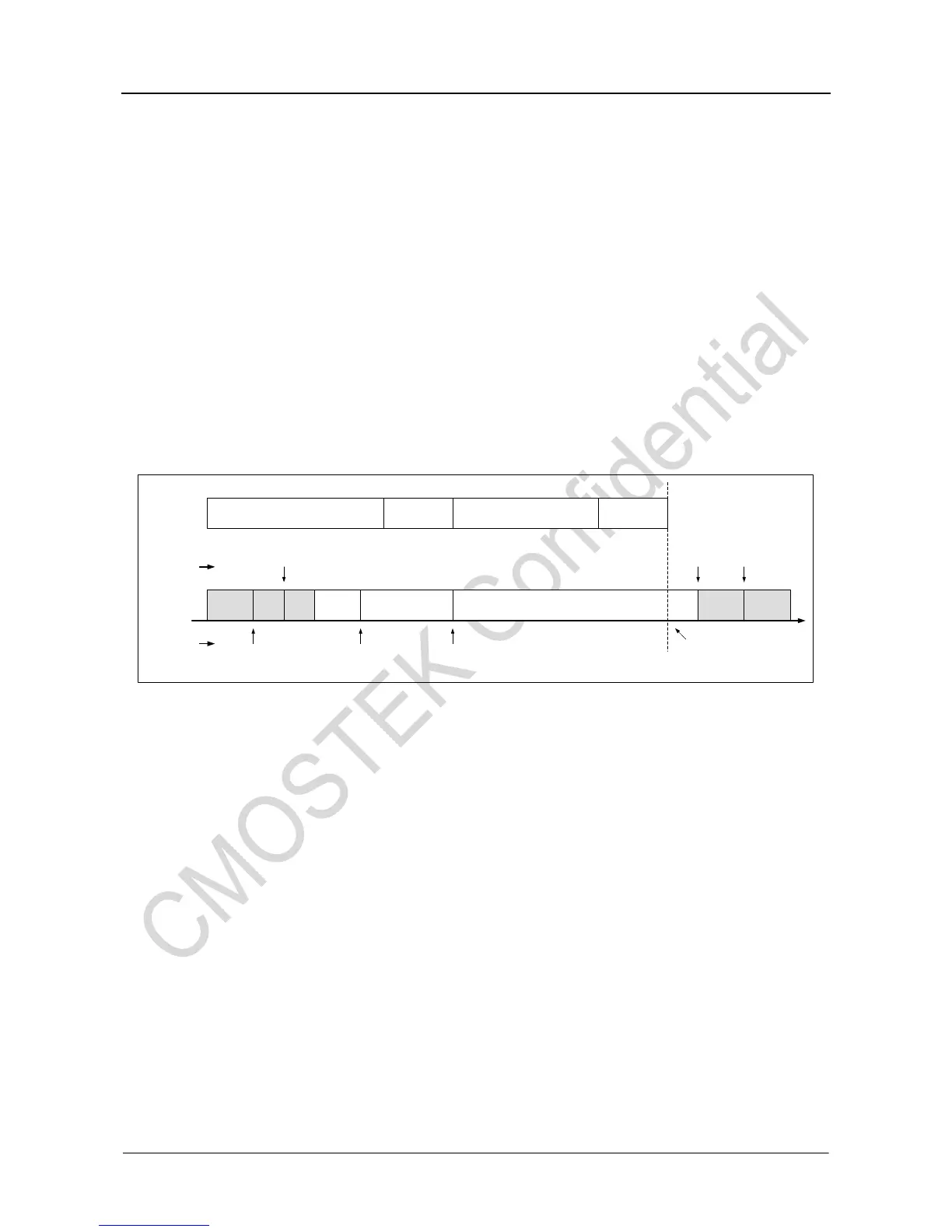
When the pattern is set to 11-13, once the detection condition is met within RX T1, switch to RX T2. Once
SYNC_OK is detected within RX T2, RX T2 will stop the timer, and the chip will stay at RX and give the control
to the MCU. Otherwise, the detection condition is not met within RX T1 or RX T2, and exit from RX after the
end of the timer. The three conditions are as follows:
11:The detection condition is RSSI_VLD valid.
12:The detection condition is PREAM_OK vallid.
13:The detection condition is RSSI_VLD and PREAM_OK valid at the same time.
Figure20. SLP Pattern 11-13
The following scenes are more suitable for using pattern 11 to pattern 13:
For the application with Preamble and Sync Word in the packet, you can use the 3 patterns. These 3
patterns advantage is, if there is the different transmitting data in the same channel, then, detecting Preamble
or RSSI alone doesn't mean that the received data is wanted, and adding the second detection condition
that meet the fixed Sync Word, will be very reliable. If the second detection condition is not met, it will exit after
RX T2. In this way, excessive power consumption is not wasted due to the error trigger
Wake up the MCU in SLPMode to send the RF data (Cmt2300_TX()). Users need to close SLPMode
first. Open SLPMode again after the sending is completed.
Cmt2300 SLP mode operation code examples see Appendix 1 for details.


 To Next Page