2.4.4 SLP Pattern 5-10
When the pattern is set to 5-10, once the detection condition is met within RX T1, switch to RX T2,
automatically exit from RX after the RX T2 timer is over. Otherwise, if the detection condition is not met within
RX T1, exit from RX after the timer is over. Six different conditions are as follows:
5:The detection condition is RSSI_VLD valid.
6:The detection condition is PREAM_OK valid.
7:The detection condition is RSSI_VLD and PREAM_OK valid at the same time.
8:The detection condition is that PREAM_OK or SYNC_OK, any one is valid.
9:The detection condition is that PREAM_OK or NODE_OK, any one is valid.
10:The detection condition is that PREAM_OK, SYNC_OK or NODE_OK, any one is valid.
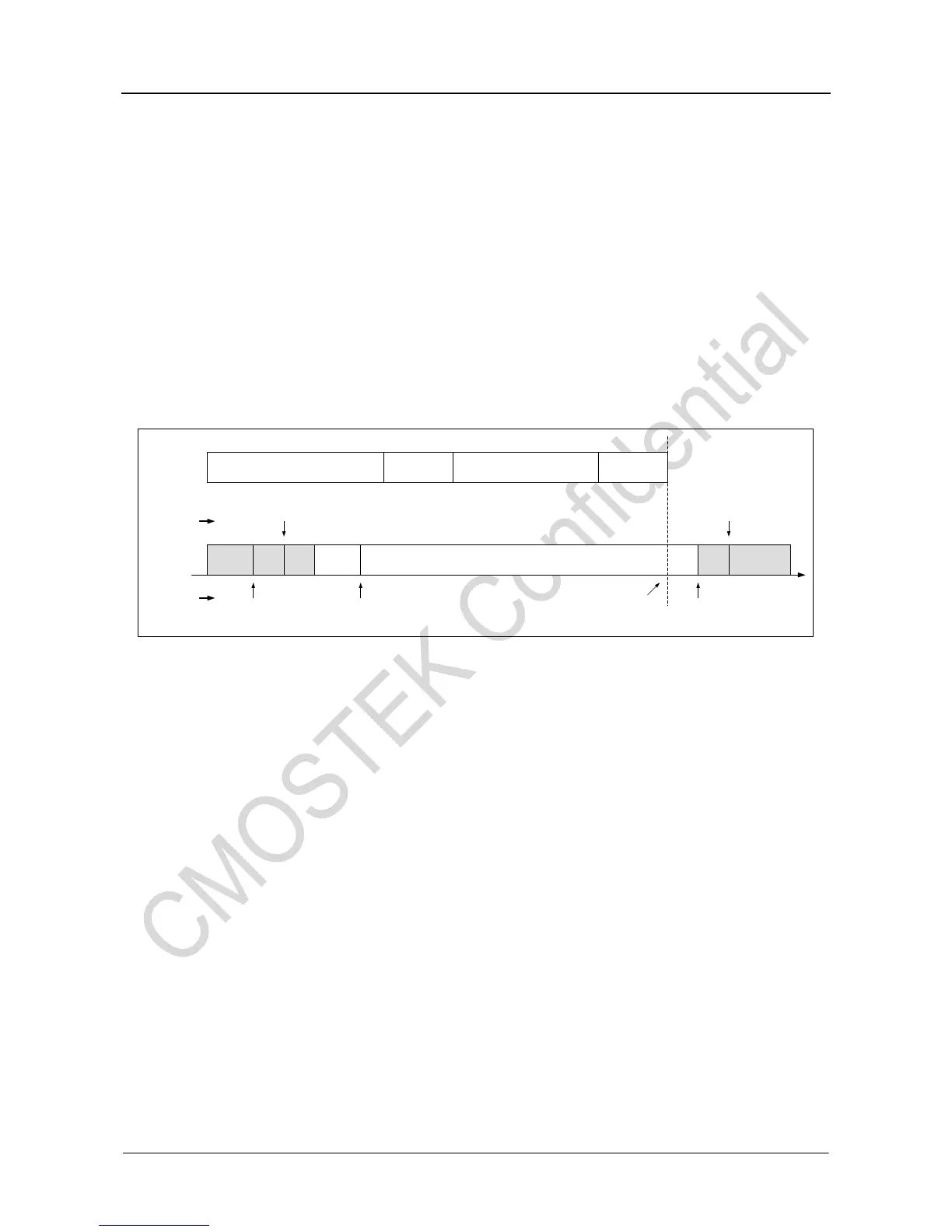
Next, take option 6 as an example to give the timing diagram of TX, MCU and RX coordination:
Figure19. SLP Pattern 4
The user needs to set the RX T2 long enough to receive all the content needed.
The following scenes are more suitable for using pattern 5 to pattern 10:
Compared to pattern 1-3, the change in pattern 5-10 is the presence of RX T2. After switching to RX T2,
the chip does not need MCU to participate in the control, nor need MCU to do overtime by itself, and will
automatically exit from RX after RX T2 is timeout. Therefore, these patterns are more suitable for the
application that each sent data length is similar, so that RX T2 time is set better.
Here are the practical meanings of patterns 8 to pattern 10:
In some applications, in order to minimize the power consumption of TX/RX, the low power transceiver
scheme will not comply with the calculation principle introduced in the chapter 9.2. For example, the RX time
is set relatively short, only the detection conditions sent by TX can be captured with probability, but the
capture of the 100% cannot be achieved. If the detection condition is set to any one of 2 or 3 conditions valid,
it will improve the probability of successful capture, but at the same time the reliability will be reduced. If the
market proves that RSSI_VLD assisted by PJD can work reliably, options 8-10 have no practical meaning.
If there is no NODE ID in the packet format, users can also use pattern 9 and pattern 10:


 To Next Page