1.2.5 Receive Full Automatically
Fully automatic receiving mode, that is, once the operation is started, there is no need the MCU (and not)
to participate in the switching status. The MCU can only obtain the chip working status by the preset interrupt,
and perform the required operation. It should be noted that before entering the full automatic receiving, the
MCU must configure the package format, the FIFO working mode, the interrupt and IO in the STBY status.
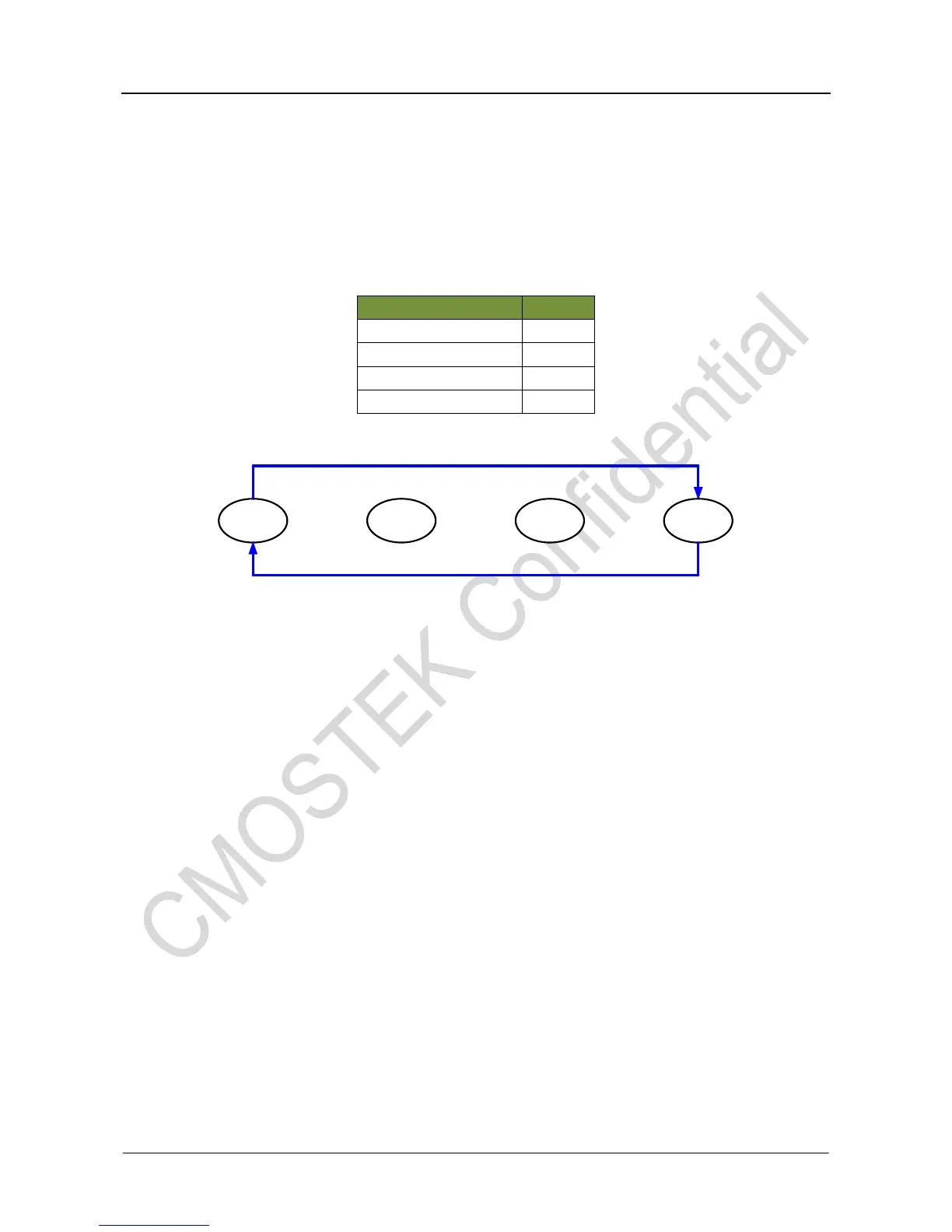
Table 8. Receive Full Automatically
Figure 6. Receiver Controls Full Automatically
The mode limitation is that MCU is fast enough, must use the interrupt to interact with the chip and finish
the FIFO reading at RX.
The first thing to note about MCU and CMT2300A cooperation is to obey the operation rule. Once the
automatic controlling is enabled, you can't manually order to do the same status switching. Also, it is important
to note that if the automatic exiting from RX is enabled and the exit status is SLEEP, then the interrupt status
in the control bank2 will be lost after exiting to SLEEP. So if you use the mode, you must think it over. Let MCU
interact securely with the chip, there will not be the situation without the interrupt. Usually we would
recommend users to set RX_EXIT_STATE to 1, which is staying in STBY after automatic exiting from RX,
then all the interrupt status will be retained, the power consumption will be reduced greatly. And after you can
let the MCU safely deal with all the work, and then manually switch to SLEEP.
1.3 TX Duty-Cycle Mode
To control the TX Duty-Cycle mode, 3 register control bits are used. For TX, no TX TIMER, because the
transmitting is active behavior, the power is very large. After transmitting in the packet mode, the default
operation of the chip is to automatically exit from the TX status. Therefore, no special counter is required to
count. The transmitting time depends entirely on the content to be transmitted.
According to the actual application requirements, here are 3 combinations of the 3 control bits and the
corresponding operation mode. The control principle is the same as the RX Duty-Cycle mode.


 To Next Page