EasyManua.ls Logo

Commodore 1541 - Disk Commands

Commodore 1541
80 pages
Print Icon
To Next Page IconTo Next Page
To Previous Page IconTo Previous Page
Loading...
4*
DISK
COMMANDS
OPEtV
AND
PRINT
#
Up
'til
now,
you
have
explored
the
simple
ways
of
dealing
with
the
disk
drive.
In
order
to
communicate
with
the
disk
drive
more
fully,
you
have
to
touch
on
the
OPEN
and
PRINTS
statements
in
BASIC
(more
details
of
these
commands
arc
available
in
yaur
VIC
20
or
Commodore
64
User's
Guide
or
Programmer's
Reference
Guide).
You
may
be
familiar
with
their
use
with data
files
on
cassette
tape,
where
the
OPEN
state-
ment
creates
the
file
and
the
PRINTS*
statement
Fills
the
file
with
data.
They
can
be
used
the
same
way
with
the
disk,
as
you
will
see
in
the
next
chapter.
But
ihey
can
also
be
used
to
set
up
a
command
channel.
The
command
channel
lets
you
exchange
infor
mation
between
the
computer
and
the
disk
drive.
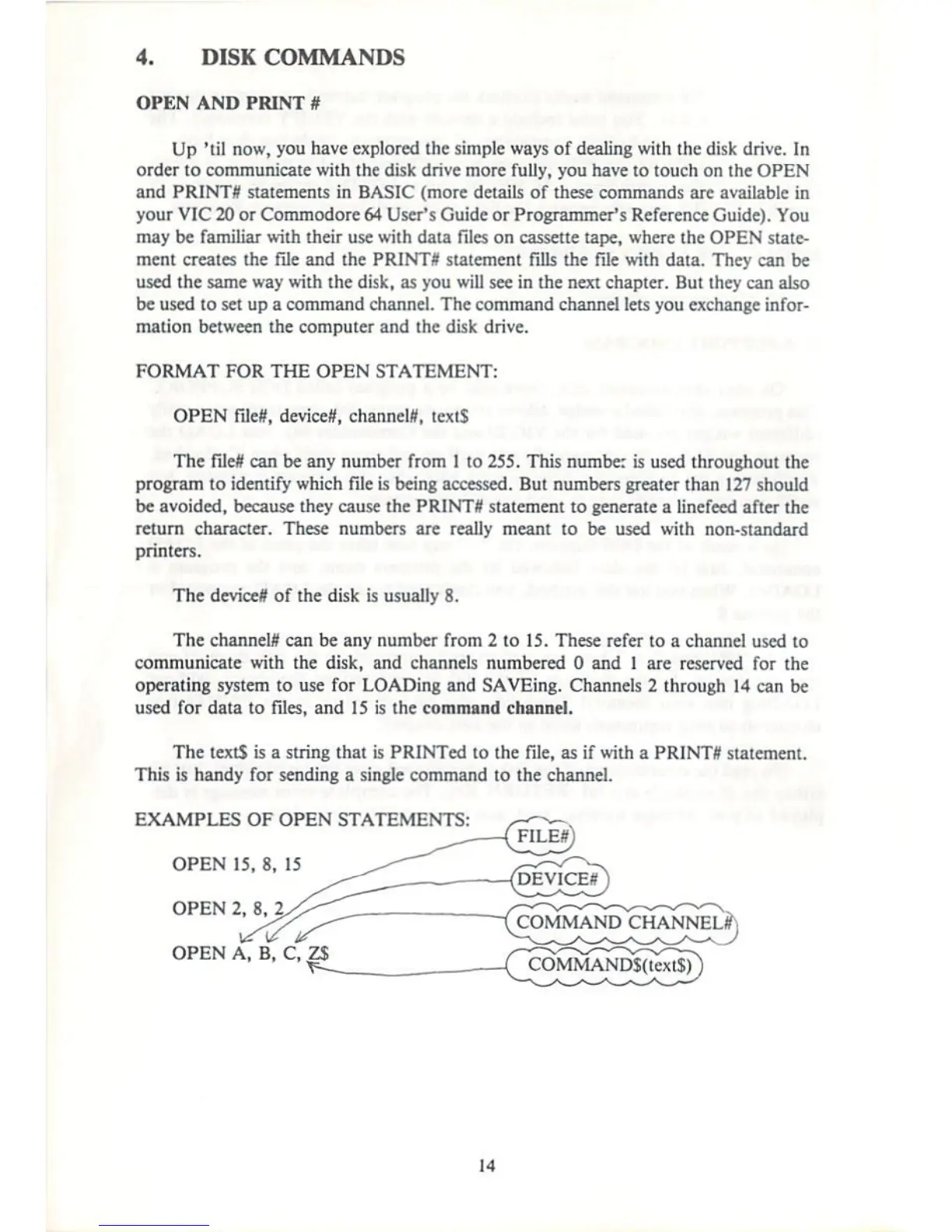
FORMAT
FOR
THE
OPEN
STATEMENT:
OPEN
filc#r
device*,
channel*,
(cxtS
The
filetf
can be
any
number
from
1
to
255.
This
numbe:
is
used
throughout
the
program
to
identify
which
Tile
is
being
accessed.
Bui
numbers
greater
than
127
should
be
avoided,
because
they
cause
the
PRINT#
statement
to generaie
a
linefeed
after
the
return
character.
These
numbers
are
rcaJiy
meant
to
be
used
with
non-standard
printers.
The
device*/
of
the disk
is
usually
8.
The
channel*
can
be
any
number
from
2
to
15.
These
refer
to
a
channel
used
to
communicate
with
the
disk,
and
channels
numbered
0
and
1
are reserved
for
the
operating
system
to
use
for
LOADing
and
SAVEing.
Channels
2
through
14
can
be
used
for
data
to
files,
and
15
is
the
command
channel.
The
textS
is
a
string
that
is
PRINTed
to
the
file,
as
if
with
a
PRINTS
statement.
This
is
handy
for
sending
a
single
command
to
the
channel,
EXAMPLES
OF
OPEN
STATEMENTS:
OPEN
15,
8,
15
COMMAND
CHANNEI
^
--_-^
^—^—^-
s
COMMANDJ(texlS)
OPEN
2,
8.2
OPEN
A,
B, C,
Z$

Other manuals for Commodore 1541

Related product manuals