EasyManua.ls Logo

Commodore 1541 - Block-Write

Commodore 1541
80 pages
Print Icon
To Next Page IconTo Next Page
To Previous Page IconTo Previous Page
Loading...
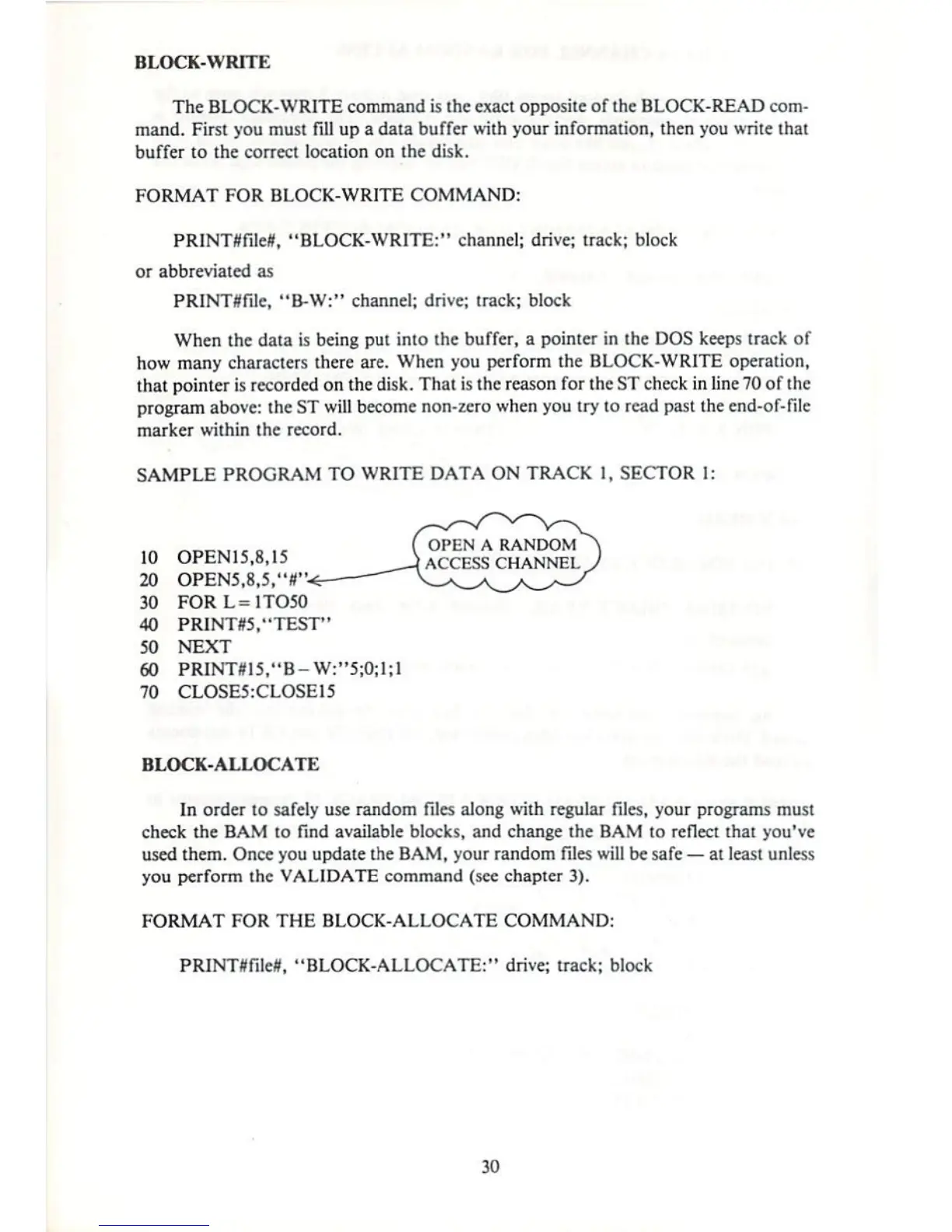
BLOCK-WRITE
The
BLOCK-WRITE
command
is
the
exact
opposite
of
the
BLOCK-READ
com
mand.
First
you
must
fill
up
a
data
buffer
with
your
information,
then
you
write
that
buffer to
the
correct
location
on
the
disk.
FORMAT
FOR
BLOCK-WRITE
COMMAND:
PRlNTfffUe*.
"BLOCK-WRITE:"
channel;
drive;
track;
block
or
abbreviated
as
PRINTtffile,
"B-W:*r
channel;
drive;
track;
block
When
the
data
is
being
put
into
the
buffer,
0
pointer
in
the
DOS
keeps
track
of
how
many
characters
there
are.
When
you
perform
the
BLOCK-WRITE
operation,
that
pointer
is
recorded
on
the
disk.
That
is
the
reason
for the
ST
check
in
line
70
of
the
program
above:
the
ST
will
become
non-zero
when
you
try
to
read
past
the
end-of-file
marker
within
the
record,
SAMPLE
PROGRAM
TO
WRITE
DATA
ON
TRACK
1.
SECTOR
1:
10
20
30
40
50
60
70
OPEN15,
OPEN5.8
FORL-
PRINTS
NEXT
8.15
1TO50
."TEST"
PRINTtfl5,"B-W;"5;O;l;l
CLOSES;
CLOSE15
[
OPEN
A
>
ACCESS
V^A
A.
RANDOM
CHANNEL
BLOCK
ALLOCATE
In
order
to safely
use
random
files
along
with
regular
files,
your
programs
must
check
the
BAM
to
find
available blocks,
and
change
the
BAM
to
reflect
that
you've
used
them.
Once
you
update
the
BAM,
your
random
files
will
be
safe
at
least
unless
you
perform
the
VALIDATE
command
(see
chapter
3).
FORMAT
FOR
THE
BLOCK-ALLOCATE
COMMAND:
PRINTtffileS,
"BLOCK-ALLOCATE:"
drive;
track;
block

Other manuals for Commodore 1541

Related product manuals