EasyManua.ls Logo

Commodore PC 20 - Paths; Pathnames

Commodore PC 20
494 pages
Print Icon
To Next Page IconTo Next Page
To Previous Page IconTo Previous Page
Loading...
16
MS-DOS User's Reference
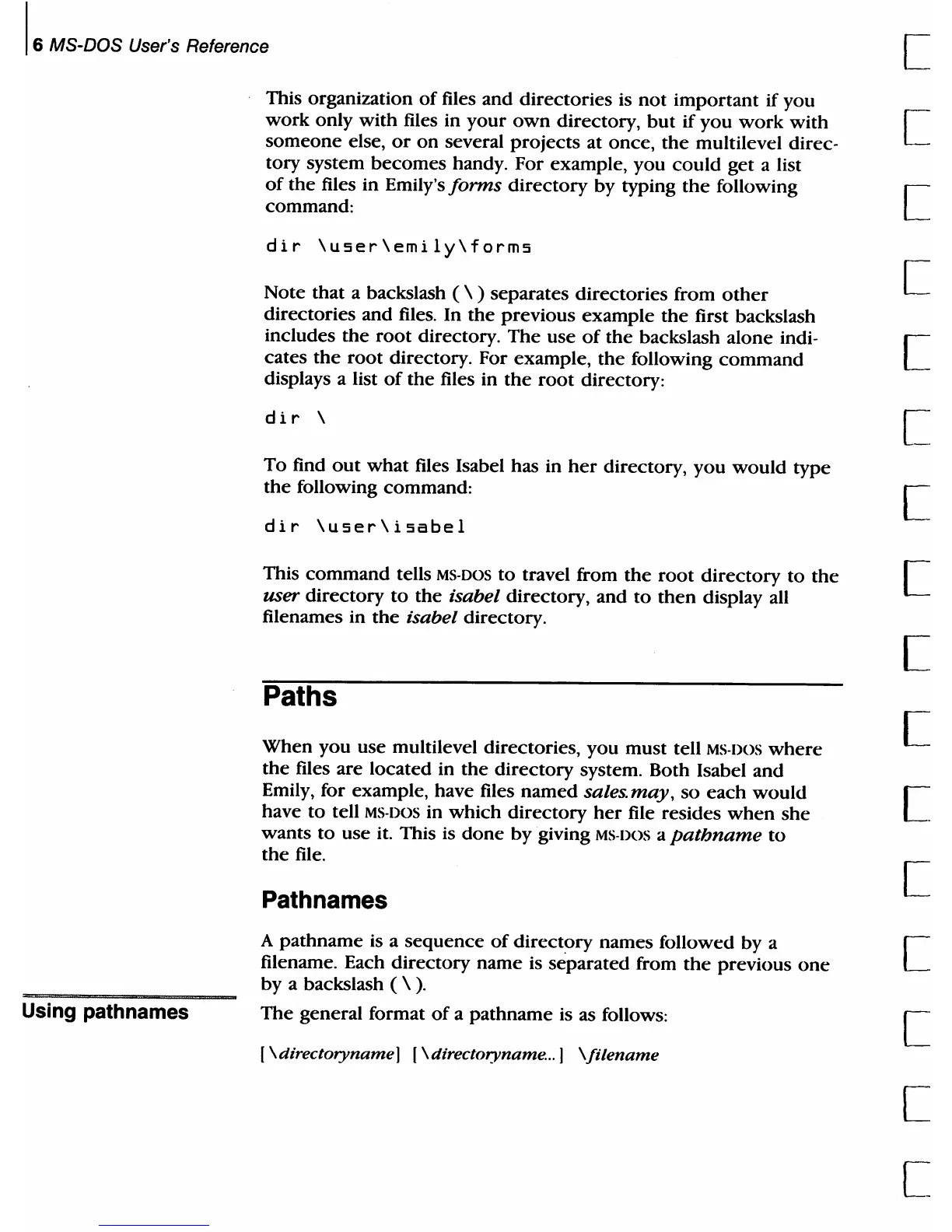
This organization
of
files and directories is
not
important
if you
work
only
with
files in
your
own
directory,
but
if
you
work
with
someone
else,
or
on
several
projects
at once,
the
multilevel direc-
tory system
becomes
handy. For example,
you
could
get
a list
of
the files in Emily's
forms
directory
by typing
the
following
command:
dir
\user\emily\forms
Note that a backslash ( \ ) separates directories from
other
directories and files. In
the
previous
example
the
first backslash
includes
the
root
directory.
The
use
of
the
backslash alone indi-
cates
the
root
directory. For example,
the
following
command
displays a list
of
the files in
the
root
directory:
dir
\
To find
out
what
files Isabel has in
her
directory, you
would
type
the
following command:
dir
\user\isabel
[
[
[
[
[
[
[
This
command
tells
MS·
DOS
to
travel from
the
root
directory
to
the
[
user
directory
to
the
isabel directory, and
to
then
display all
Using path
names
filenames in
the
isabel directory.
Paths
When
you
use multilevel directories,
you
must
tell MS·DOS
where
the
files are located in
the
directory
system. Both Isabel and
Emily, for example, have files
named
sales.
may,
so
each
would
have
to
tell
MS·
DOS in
which
directory
her
file resides
when
she
wants
to
use it. This is
done
by
giving
MS·
DOS a
patbname
to
the
file.
Path
names
A
pathname
is a
sequence
of
directory
names followed by a
filename. Each
directory
name is separated from
the
previous
one
by a backslash ( \
).
The
general format
of
a
pathname
is as follows:
[\directoryname)
[\directoryname
...
)
\filename
[
[
[
[
[
[
[
[

Table of Contents

Related product manuals