EasyManua.ls Logo

Commodore PC 20 - Wildcards; The? Wildcard

Commodore PC 20
494 pages
Print Icon
To Next Page IconTo Next Page
To Previous Page IconTo Previous Page
Loading...
\s
MS-DOS User's Reference
Using
the?
wildcard
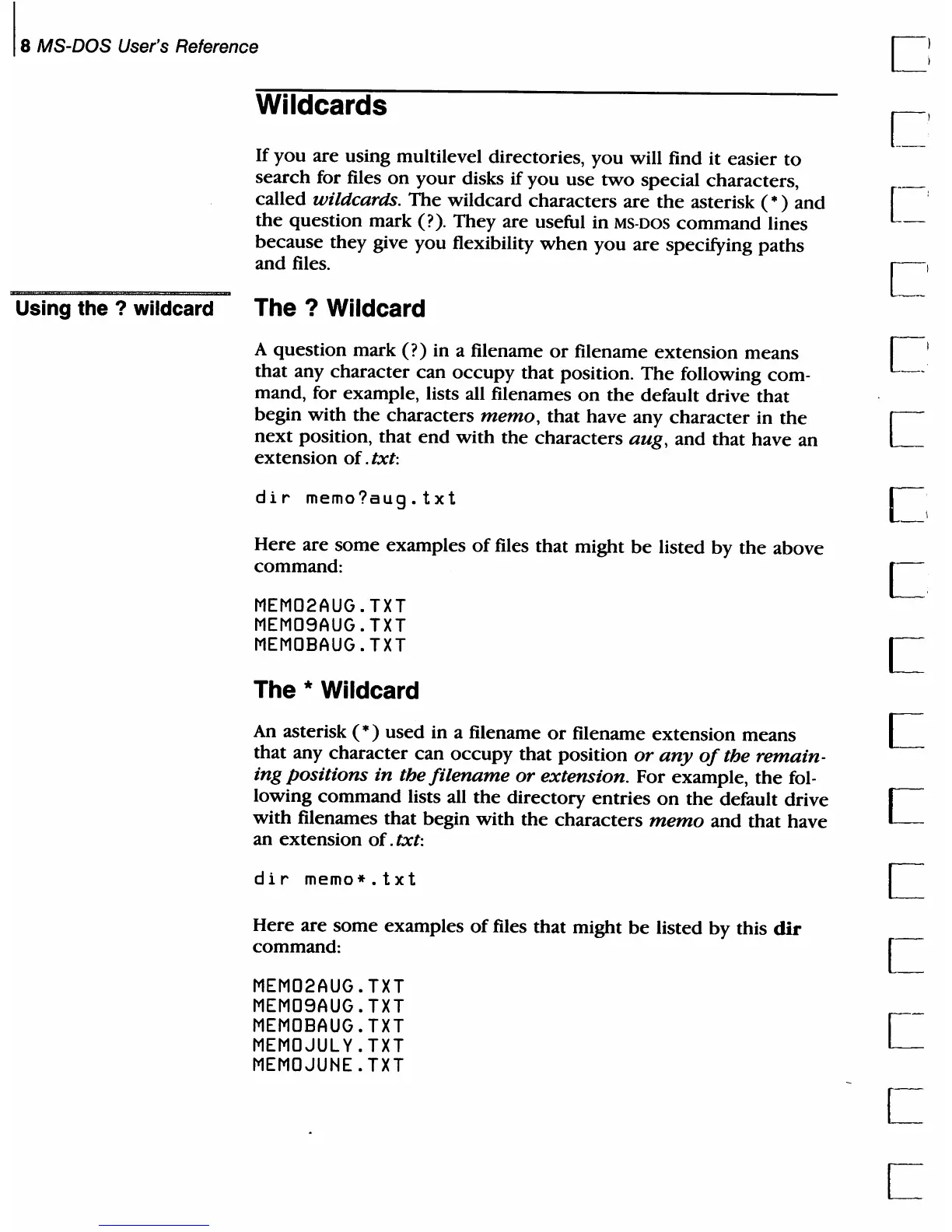
Wildcards
If
you
are using multilevel directories,
you
will find it easier
to
search
for files
on
your
disks
if
you
use
two
special characters,
called
wildcards.
The
wildcard
characters
are
the
asterisk
(.)
and
the
question mark (?).
They
are useful in
MSĀ·
DOS
command
lines
because they give
you
flexibility
when
you
are
specifying
paths
and files.
The ? Wildcard
A question mark
(?)
in a filename
or
filename
extension
means
that
any character
can
occupy
that
position.
The
following com-
mand, for example, lists all filenames
on
the
default drive that
begin
with
the
characters
memo,
that
have any
character
in
the
next
position, that
end
with
the
characters aug, and
that
have an
extension
of.
txt:
dir
memo?aug.txt
Here are
some
examples
of
files that might
be
listed
by
the
above
command:
MEMo2AUG.
TXT
MEMo9AUG.TXT
MEMo8AUG.TXT
The * Wildcard
c'
L,
An
asterisk
(.)
used in a filename
or
filename
extension
means C
that any character
can
occupy
that
position
or
any
of
the remain-
ing positions
in
the
filename
or extension. For example,
the
fol-
lowing
command
lists all
the
directory
entries
on
the
default
drive
C
with
filenames that begin
with
the
characters
memo
and
that
have
an extension
of
. txt:
dir
memo*.txt
c==
Here are
some
examples
of
files that might
be
listed
by
this dir [
command:
MEMo2AUG.TXT
MEMo9AUG.TXT
r--
MEMo8AUG.
TXT
L
MEMoJULY.TXT
MEMO
JUNE
.
TXT

Table of Contents

Related product manuals