EasyManua.ls Logo

Commodore PC 20 - Page 354

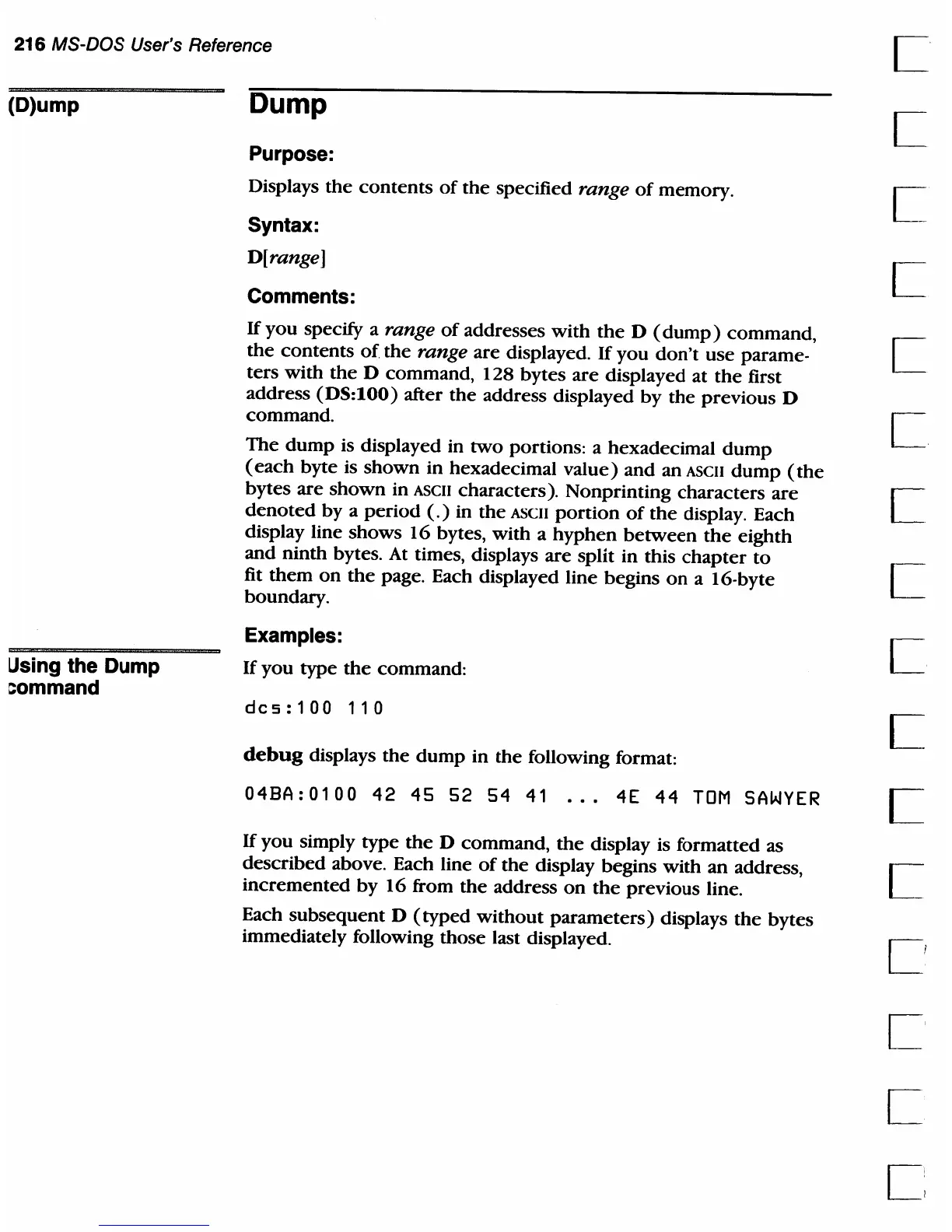
Commodore PC 20
494 pages
Print Icon
To Next Page IconTo Next Page
To Previous Page IconTo Previous Page
Loading...
216 MS-DOS User's Reference
(D)ump
lJsing
the Dump
~ommand
Dump
Purpose:
Displays
the
contents
of
the
specified
range
of
memory.
Syntax:
D[range]
Comments:
If
you
specify a range
of
addresses
with
the
D
(dump)
command,
the
contents
of
the
range
are
displayed.
If
you
don't
use
parame-
ters
with
the
D command, 128 bytes
are
displayed at
the
first
address
(DS:I00)
after
the
address displayed
by
the
previous
D
command.
The
dump
is displayed in
two
portions: a hexadecimal
dump
(each
byte is
shown
in hexadecimal
value)
and
an ASCII
dump
(the
bytes
are
shown
in ASCII characters). Nonprinting characters
are
denoted
by a
period
(.)
in
the
ASCII
portion
ofthe
display. Each
display line
shows
16
bytes, with a
hyphen
between
the
eighth
and
ninth bytes.
At
times, displays
are
split in this
chapter
to
fit
them
on
the
page. Each displayed line begins
on
a 16-byte
boundary.
Examples:
If
you
type
the
command:
dcs:100
110
debug
displays
the
dump
in the following format:
04BA:
01
00
42
45
52 54
41
•••
4E
44
TOM
SAWYER
If
you
simply type
the
D command,
the
display is formatted as
described above. Each line
of
the
display begins
with
an
address,
incremented
by
16 from
the
address
on
the
previous
line.
Each
subsequent
D
(typed
without
parameters)
displays
the
bytes
immediately following those last displayed.
LI

Table of Contents

Related product manuals