EasyManua.ls Logo

Commodore PC 20 - Page 367

Commodore PC 20
494 pages
Print Icon
To Next Page IconTo Next Page
To Previous Page IconTo Previous Page
Loading...
[
[
[
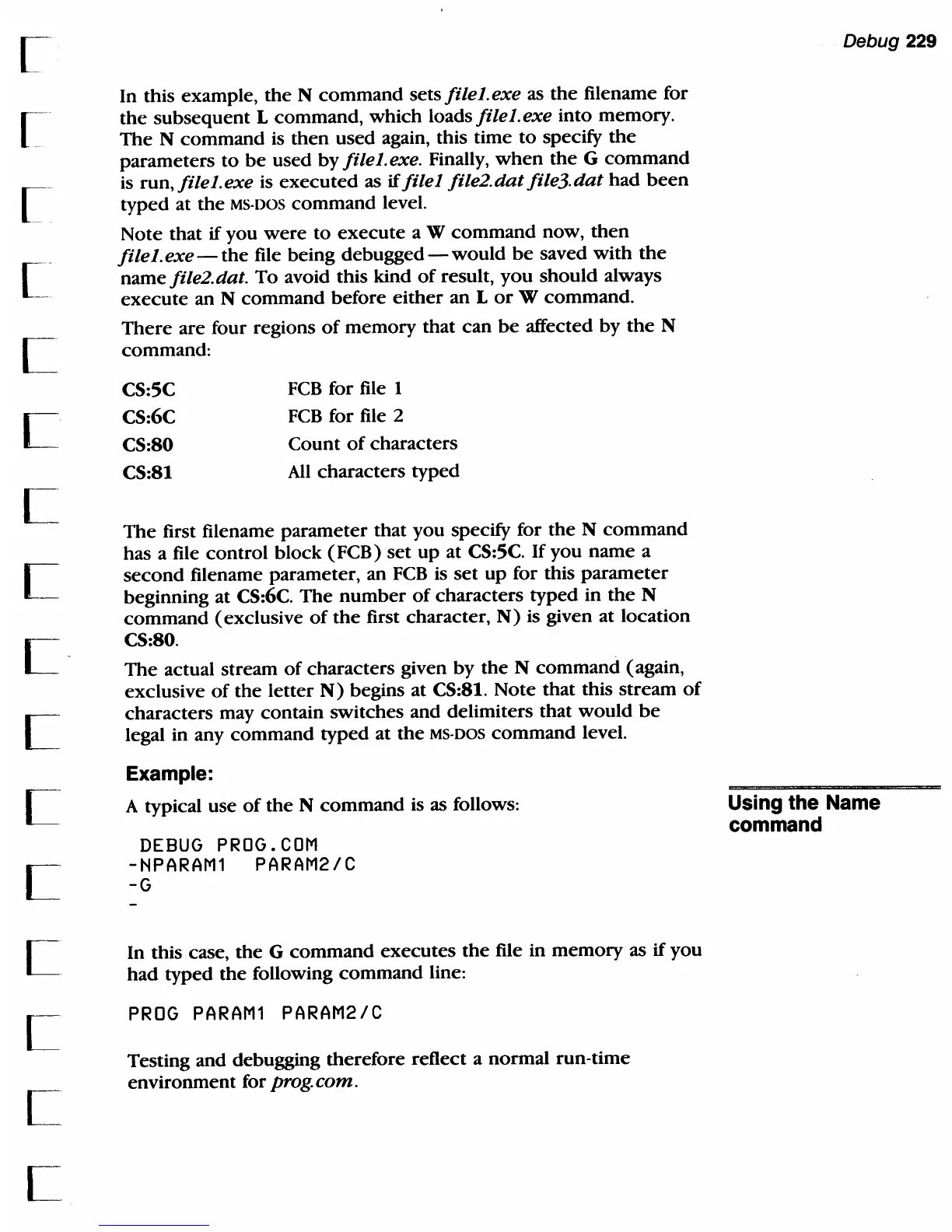
In this example,
the
N
command
setsfilel.exe
as
the
filename for
the
subsequent
L command,
which
loads
filel.exe
into
memory.
The
N
command
is
then
used
again, this time
to
specify
the
parameters
to
be
used by
filel.exe.
Finally,
when
the
G
command
is
run,filel.exe
is
executed
as
iffilel
file2.dat file3.dat
had
been
typed
at
the
MSĀ·DOS
command
level.
Note
that
if
you
were
to
execute
a W
command
now,
then
filel.exe-the
file being
debugged-would
be
saved
with
the
name
file2.dat.
To avoid this kind
of
result,
you
should
always
execute
an N
command
before
either
an L
or
W command.
There
are four regions
of
memory
that
can
be
affected by
the
N
command:
CS:5C
CS:6C
CS:80
CS:81
FeB for file
1
FCB
for file 2
Count
of
characters
All
characters
typed
The
first filename
parameter
that
you specify for
the
N
command
has a file
control
block (FCB)
set
up
at CS:5C.
If
you
name
a
second
filename parameter, an
FCB
is
set
up
for this
parameter
beginning at CS:6c.
The
number
of
characters typed in
the
N
command
(exclusive
of
the
first character,
N)
is given at location
CS:80.
The
actual stream
of
characters given by
the
N
command
(again,
exclusive
of
the
letter
N)
begins at CS:81.
Note
that
this
stream
of
characters may contain switches and delimiters that
would
be
legal in any
command
typed
at
the
MS-DOS
command
level.
Example:
A typical use
of
the
N
command
is as follows:
DEBUG
PROG.COM
-NPARAM1
PARAM2/C
-G
In this case,
the
G
command
executes
the
file in
memory
as
if
you
had
typed
the
following
command
line:
PROG
PARAM1
PARAM2/C
Testing and debugging therefore reflect a normal run-time
environment for
prog.com.
Debug 229
Using the Name
command

Table of Contents

Related product manuals