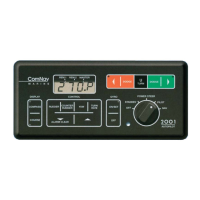
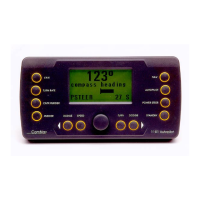
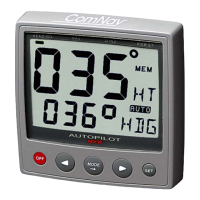
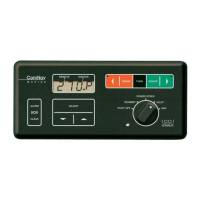
ComNav 2001 Autopilot System
P/N 29010017 V1.0 - 48-
Typical values for RUDDER, COUNTER
RUDDER, YAW and TURN RATE which
seem to work on most vessels in the 30 to 60 foot
range are 4, 4, 1, and 6 respectively. When in
doubt about how to determine the settings, try
these. If you make a large turn, and you see by
watching the vessel's actual heading display as
you come around that you overshoot the new
course, try either increasing the amount of
COUNTER RUDDER by one setting, or
reducing the amount of RUDDER by one setting,
and do it again.
If the vessel seems to stop turning before you get
to the new course, and then slowly come up to it,
try either decreasing the amount of COUNTER
RUDDER, or increasing the amount of
RUDDER.
If nothing seems to make the vessel steer
properly, or it steers properly on some headings
but not on others, particularly north or south, it is
almost always a problem with the compass. The
card may be sticking because of a worn pivot; the
compass may not have been swung by a qualified
compass adjuster; or the compass may not have
been swung properly the first time.
On new steel vessels in particular, the magnetism
of the hull can change dramatically over time, and
it is not uncommon to require the compass to be
swung twice in the first year. Also there is a
common misconception that aluminum vessels
don't require the compass to be swung because
aluminum is non-magnetic. It is, but the welds
where the aluminum plates are joined become
magnetic because of the amount of energy
injected there. For this reason, having the
compass properly swung is just as important on
an aluminum vessel as a steel vessel.
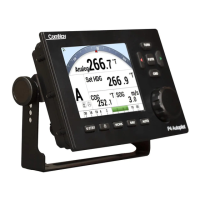
You can see either the programmed course or the
vessels’ actual heading on the display. Press the
COMPASS key to display the vessel's actual
heading. This will remain on the display until you
press the COURSE key, or any of the red or
green ARROW or DODGE keys, or the U-
TURN key. Any of these will return the display
to the programmed course.
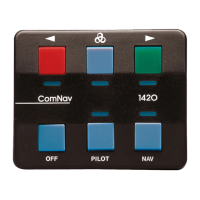
The DODGE keys may be used to avoid a log or
other obstacle in the water ahead. Pressing one
DODGE key will cause the vessel to make a
panic turn in that direction. Pressing both
DODGE keys when the vessel has turned far
enough to miss the obstacle, will make the
autopilot bring the rudder to dead ahead and hold
it there.
Release the DODGE keys to return the vessel to
the original course at the programmed turn rate
when the vessel is clear of the obstacle. The
Function Indicator will show a 'd' until the dodge
is complete.
The next operating mode is NAV. If you have a
Loran or other navigation computer interfaced to
the autopilot, program in a waypoint, tell the
computer to begin navigating towards the
waypoint from the vessel's present position, and
turn the autopilot master select switch to NAV.
For one second, you will see which nav port is
selected as well as the cross track error sense
setting for that port.
To change the nav port, press the U-TURN key
followed by the red ARROW key. To change the
cross track error sense for that nav port press the
U-TURN key followed by the green ARROW
key.
If your interface is using either the NMEA 0182
or 0183 data format, the first thing that should
happen is the course the autopilot is steering will
begin to change towards the Heading to the
Waypoint as indicated by the Nav. Device. The
autopilot will then begin to alter its course to keep
the Cross Track Error as indicated by the Nav.
Device to a minimum.
WATCH THE CROSS TRACK ERROR if you
are in any doubt as to whether things are working
correctly. If it is being maintained at a low value
(Example less than 0.02 nautical miles),
everything is working.
If the vessel is wandering back and forth, but
there are no alarms on the autopilot or Nav.
Device, the most common thing, particularly with
Loran, is poor signal quality. This can be usually
attributed to either poor or no grounding of the
Loran, noisy alternators on the vessel, poor
antenna location, or shared data being loaded by
other devices. Refer to the manual for the Nav.


 To Next Page
 Loading...