ComNav 2001 Autopilot System
P/N 29010017 V1.0 - 49-
Device for ideas on making improvements. If the Nav. Device is set for automatic waypoint
sequencing, the heading to steer will change
when the next waypoint is selected, and the
autopilot will turn the vessel to the new course.
Some things that will optomize the pilots
operation are:
1.) If the heading to steer can be in degrees
magnetic or degrees true, select degrees
magnetic, unless you are using the optional
gyrocompass interface.
2.) Course changes during automatic waypoint
sequencing will be smoother if the arrival circle is
set to a small value such as 0.05 nautical miles.
This usually will let the autopilot bring the vessel
directly onto the next track when the course
change is completed.
If your interface uses the NMEA 0180 format, the
autopilot does not know the direction to the
waypoint, but only how far it is off the line
between the beginning and end of the track and to
which side. Typically, up to .10 or more nautical
miles of cross track error will build up before the
autopilot begins to find the heading to the
waypoint. The autopilot will also probably cross
the track one or two times before it finally locks
onto it.
To reduce the initial wander, preset the vessel's
course to the approximate heading to the
waypoint using the red or green ARROW keys
with the autopilot in the PILOT mode. Once the
autopilot has found the track, it will perform just
as well as with the NMEA 0182 or 0183 formats.
However, if the Nav. Device is set for automatic
waypoint sequencing, the autopilot will have to
go through the cycle of finding the track again
after each time the Nav. Device sequences
waypoints.
You can still use the DODGE keys to avoid
obstacles in the water. After you release the
DODGE keys, the vessel will return to its
original track, rather than its original course.
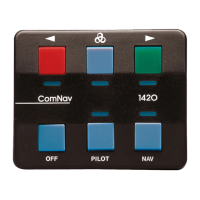
To use the remote control, leave the autopilot in
the STANDBY mode when you go up to the
flying bridge. This will leave the vessel under the


 To Next Page