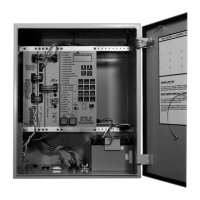
VR-32 Regulator and CL-4C Control
4-1
WARNING: When trouble shooting energized
equipment, caution should be taken to wear pro-
tective gear and to avoid personal contect with ener-
gized parts. Failure to do so may cause serious injury
or death.
!
NOTICE: Use only 350 volts ac, slow-blow
ceramic fuses of the proper current rating. Failure
to do so may cause unnecessary fuse operation or
insufficient protection of the regulator and control.
!
TROUBLE SHOOTING GUIDE • Section 4
COMPLETE REGULATOR IN SERVICE
External Check
When service personnel arrive at what appears to be a mal-
functioning regulator, it is advisable to examine the power con-
nections first. For example, verify that the source lead is con-
nected to the source bushing; that the load lead is connected
to the load bushing; and that the source-load lead is connect-
ed to the sourceload bushing. Check other potential problems,
such as an open ground connection.
Defining The Problem
Figures 1-17, page 1-16 can be used while diagnosing the
problem.
After the external power connections have been checked,
check the voltage-disconnect knife switch (V
1
and V
6
if pre-
sent) and the current shorting knife switch (C) of the rear
panel signal circuit in the control box. Close the voltage dis-
connects if open. open shorting switch, if closed.
Check for loose connections or burnt wiring.
Make sure ratio-correcting transformer RCT1 is on the cor-
rect tap for the regulated voltage shown on the nameplate on
the control box door.
Remove the motor and panel fuses from the control and
check for continuity across each fuse. Spares, if needed are
included with the control.
If the above checks do not identify the problem, determine
which of the following three categories best describes the mal-
function, and follow the corresponding diagnostic steps:
THE REGULATOR WILL NOT OPERATE MANUALLY OR
AUTOMATICALLY
Diagnosing trouble:
A. Set the CONTROL switch on RAISE.
B. Measure the voltage between terminals R
1
and G on termi-
nal board TB1. The voltage reading should be approximate-
ly the set voltage setting.
C. Set the CONTROL switch on LOWER.
D. Measure the voltage between terminals L
1
and G on termi-
nal board TB1. The voltage reading should be approximate-
ly the set voltage setting.
E. If correct voltage readings are obtained in steps B and D
above, the trouble may be in the position indicator, junction
box, or control cable. Refer to the junction box trou-
bleshooting section on page 4-2.
G. If there is no voltage measurement in either step B or D,
make a corresponding measurement (R
3
to G and L
3
to G)
on lower terminal board TB2.
H. If the voltages measured in Step G are approximately the
set voltage setting then the fault is likely a loose connection
or a faulty terminal swage between TB1 and TB2.
I. If steps B, D, and G do not provide voltage readings, measure
the voltage between VM and G on terminal board TB2. The
reading should be approximately the set voltage setting.
J. If Step I measures correctly, the trouble could be an open
motor fuse, power switch, or control switch of the control.
K. If Step I does not yield a voltage measurement check the volt-
age between PD
1
1 (V1) and ground (G) at the voltage dis-
connect knife switch.
1. If approximately the set voltage setting is obtained, the V1
disconnect or the ratio correcting transformer (RCT1 ) of
the rear panel signal circuit is probably faulty.
2. If voltage is not obtained, the trouble is in the control cable
junction box, or regulator tank. Refer to the junction box
troubleshooting section on page 4-2. If the junction box
checks are satisfactory, the trouble is in the regulator tank.
See
S225-10-2
for the trouble shooting method.
THE REGULATOR WILL OPERATE MANUALLY BUT
NOT AUTOMATICALLY
Diagnosing trouble:
A. Measure voltage from VS to G on lower terminal board TB2.
1. A measurement of approximately the set voltage setting at
VS to G indicates that the problem is in the control.
2. If there is no voltage present at VS to G, the trouble is in
the V1 disconnect or ratio-correcting transformer of the
rear signal circuit.
B. If check A indicates that the trouble is in the control, refer to
Control Trouble Shooting,
below.
THE REGULATOR OPERATES MANUALLY BUT
OPERATES INCORRECTLY WHEN SET ON AUTOMATIC
Diagnosing trouble:
Run the regulator to the neutral position with the control switch.
Check for voltage between V
4
and G on TB1. This is the sensing
circuit supply voltage from the output of RCT1 on the rear panel.
If this voltage is more than 10% above or below the programmed
voltage level setting of the control, then the source is beyond the
range of the regulator. An absence of voltage would indicate a
wiring problem such as an opening somewhere in the control
power supply. If these checks are correct, then the malfunction is
probably in the control. Refer to
Control Trouble Shooting,
below.
Junction Box Trouble Shooting
This section is used if the regulator will not operate manually.
(Problem was isolated to junction box or regulator tank after
checking-out control, on page 4-1).
The junction box is composed of a terminal board, the position
indicator, and the control box interconnections. Refer to Figure
4-1, when the following steps are made:
1. Remove the regulator from service, as stated on page 1-8.
2. Ground the three high-voltage bushings.
3. Open V
1
disconnect switch on rear panel (and V
6
if present)
of control cabinet.
4. Remove junction box lid.
5. Check the wiring on the junction box terminal board for loose
connections, burnt wiring, or bad swage joints.
6. A. Set the POWER switch to EXTERNAL.
B. Apply a 60/50 Hz, 120-volt ac nominal variable source to
the EXTERNAL SOURCE terminals.
C. Set the CONTROL switch on RAISE.
D. Lift the RAISE/LOWER switch.


 To Next Page