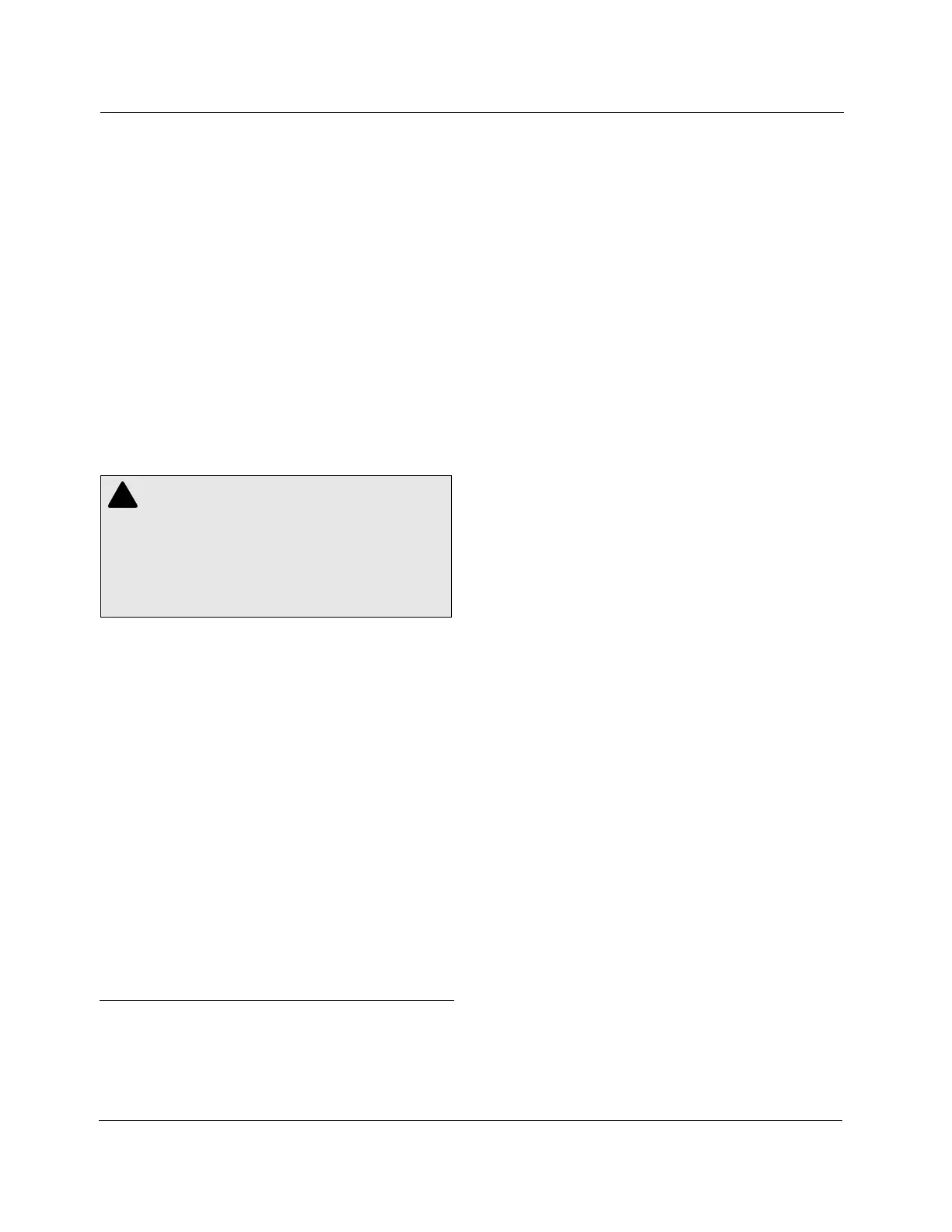
VR-32 Regulator and CL-2A Control
4-3
CAUTION: It must be verified that BOTH the
neutral light AND the position indicator hand indi-
cate NEUTRAL when the tap changer is physical-
ly in the neutral position. Lack of the synchronization
will cause an indefinite indication of NEUTRAL.
Without both indications of neutral, bypassing of the
regulator or at a later time will not be possible, and the
line must be de-energized to avoid shorting part of the
series winding.
!
14. Connect a 120-volt ac external power supply to the control.
15. Run the tap changer manually to verify alignment of the
position indicator hand and the neutral light. If correction
is required:
A. Stop the tap changer with the neutral light on.
B. Disconnect the flexible shaft from the back of the indicator.
C. Turn the indicator shaft to center the hand at zero (neutral).
D. Reconnect the flexible shaft.
16. Run the tap changer to both raise and lower extremes to
check operation of the limit switches and coordination
with holding switch.
17. Run between position nine raise and nine lower to check
neutral light and position indicator alignment. Run sever-
al cycles.
18. Should the alignment of the position indicator hand and
the neutral light become unstable during this check, an
internal inspection of the tap changer and position indi-
cator shaft is required. See S225-10-2 for instructions.
19. Return the tap changer to the neutral position and dis-
connect the power supply.
20. Replace the junction box cover.
21. The unit may now be placed into service as outlined on
page 1-5.
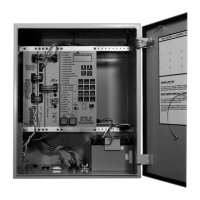
FRONT PANEL TROUBLE SHOOTING
At this point, the problem has been determined to be in the
control, so the front panel should be taken out of the control
cabinet and taken to a service bench for trouble shooting.
Figure 2-3 and 4-2 can be used to aid the trouble shooting
process. Except for the line drop compensation circuit, the
panel components are checked by using an external voltage of
approximately 120 volts ac, 50/60 Hz, applied to the external
source terminals of the control.
1. Check the motor and panel fuses to ensure they have not
blown.
2. Place the power switch on the EXTERNAL position.
3. On the power switch, measure the voltage from terminal 2
to ground and terminal 5 to ground. These measurements
should be equal to the external voltage applied. If not, the
power switch is defective.
4. Set the LDC CONTROL switch on the OFF position and the
VOLTAGE SETTING fine adjustment to 0. With an ac volt-
meter having at least 1OOO ohms/volt connected to the
INPUT (terminals 10 and 11 ) of the circuit board, perform
the following measurements at each setting indicated:
Measure Voltage at Input
Coarse Voltage Setting Terminals
105 66.9
110 63.9
115 61.1
120 58.6
125 56.3
10 54.1
Since this is not a calibration type measurement, there may be
some variation in these measurements depending upon how
close to 120.0 volts the applied voltage actually is. Expect less
than 3% variation. The objective is to look for sudden discontini-
ties in the voltage measurements. If the measurements are dra-
matically different from those above, or if discontinuities are
observed, suspect either the coarse VOLTAGE SETTING (VSC1)
switch or the INPUT POTENTIAL TRANSFORMER (IPT). The
problem can be isolated by checking the components individually.
5. With the coarse VOLTAGE SETTING switch on the 120-volt posi-
tion, vary the fine VOLTAGE SETTING rheostat from zero (0) to
5.0 volts. The measured voltage (at the INPUT terminals) should
drop smoothly about 2.5 volts. If no variation occurs, or if discon-
tinuities are observed, suspect either the fine VOLTAGE SET-
TING rheostat (VSC2) or transformer (IPT).
The front panel circuits for the DRAG-HAND RESET solenoid
(DHR) and NEUTRAL LIGHT (NL) can be checked as follows:
a. Connect the ac voltmeter from G to DHR on the fanning strip
TB2.
b. Depress the DRAG-HAND RESET toggle switch and observe
approximately 120-volts on the voltmeter. If no voltage is mea-
sured, the switch is probably defective.
c. Connect the AC voltmeter from G to NL on fanning stripTB2. d.
Activate the NEUTRAL LAMP TEST toggle switch and observe
approximately 120 volts on the voltmeter and note that the neu-
tral light should come on. If no voltage is measured and the light
does not come on, the switch is probably defective. If voltage is
measured but the light does not come on, the lamp or lamp hold-
er is defective.
The line drop compensation components should be checked next,
but only if there is strong suspicion of a problem. In reality, field fail-
ures of these components is extremely rare. To perform this analysis,
the printed circuit board must first be disconnected by dropping the
fanning strip away from the circuit board terminal strip. This proce-
dure requires a current source of .200 amps which will periodically
be readjusted during the test as a result of the changing loading con-
ditions. The procedure follows:
1. Switch the POWER switch to EXTERNAL.
2. Connect a jumper from the EXTERNAL SOURCE terminal to
ground.
3. Apply and maintain a test current source of 0.2 amp from C1 to
C3 on the fanning strip for terminal strip TB2.
4. Connect a 1000 ohms/volt ac voltmeter to the terminals marked
INPUT on the fanning strip for the printed circuit board.
5. Switch the LDC control switch to (+X+R).
6. Set the coarse and fine REACTANCE controls (X1 and X2) to
zero (0).
7. Vary the RESISTANCE control (R1 ) and read the voltage at the
major points across the dial. The measured voltage at these
points should be half the RESISTANCE control dial setting
±3.5%. Erratic behavior indicates a defective resistance control.
A serious deviation from expected readings at all levels indi-
cates a defective R2. R2 is selected to yield a resistance of 270
ohms ±3.5% from terminal 1 to terminal 3 of the resistance con-
trol (R1).
8. Set the RESISTANCE. control at 24 volts on the panel and
switch the LDC control from the (+X+R) setting through the
other two positions (-X+R and +X-R). The voltage reading
should be constant. Any change indicates a probable defective
LDC control switch.
9. Check the coarse REACTANCE control. A. Set the RESIS-
TANCE control to zero (0).


 To Next Page