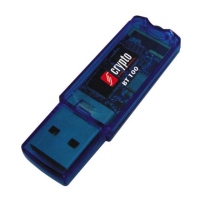
AirData 150 S2 USB User Manual
73
4. Glossary
802.1x: The IEEE 802.1x is a standard for user authentication on networks.
Access Point: A hardware device or a computer's software that seamlessly connects wired
and wireless networks.
Ad-Hoc: An independent wireless LAN network formed by a group of computers equipped
with wireless network adapters.
ADSL: Asymmetric Digital Subscriber Line is a new technology that allows more data to be
sent over existing copper telephone lines. ADSL supports data rates from 1.5 to 8 Mbps
downstream and from 16 to 640 Kbps upstream.
ASCII: American Standard Code for Information Interchange is a code for representing
characters as numbers. Each letter is represented as a number from 0 to 127. ASCII was
originally developed for communications and uses only seven bits per character. Since
computers use 8-bit byte (256 character combinations) and ASCII uses only the first 128 (0-
127), the second set of 128 characters (128-255) are technically not ASCII, but are typically
used for different language and math symbols representation.
Authentication: The process of identifying a network client usually based on a username and
password.
Beacon: A beacon is a packet broadcasted by the Access Point / Router in order to keep the
network synchronized.
CCX: The Cisco Compatible eXtensions Program for WLAN devices, is a program that
provides compatibility testing for compliance with proprietary Cisco wireless features.
Channel: A channel is a separate path through which signals can flow.
DHCP: Dynamic Host Configuration Protocol is a protocol that automatically assigns dynamic
IP addresses to devices on a network.
DSSS: Direct Sequence Spread Spectrum is a transmission technology where a data signal
is combined with a higher data rate bit sequence. The additional bits increase the signal's
resistance to interference.


 To Next Page