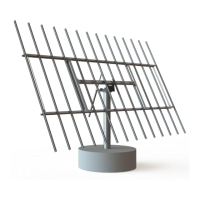
This document serves as the Assembly and Operating Manual for DEGER D25H, D60H, D80, and D100 solar tracking systems, providing comprehensive instructions for their installation, operation, and maintenance.
Function Description
The DEGER systems are designed for the tracking of photovoltaic modules, ensuring optimal solar energy capture. These systems are not intended for any other use, such as concentrated modules, mirrors, or other purposes. They are suitable for outdoor installation and building integration, maximizing energy yield by precisely orienting solar modules towards the sun. The systems utilize a patented control and patented mechanical design to achieve maximum efficiency, resulting in a significant increase in yield. The MLD-control (Maximum Light Detection) is a key component, designed to operate with maximum efficiency and to perform only such movements that will result in an immediate increase in yield.
Important Technical Specifications
The DEGER systems come in various models, each with specific technical specifications:
DEGER D25H:
- Nominal output (depending on module type): 2,000 – 6,000 Wp
- Module surface up to: 25 m²
- Max. module surface up to (West): 5.05 m x 5.05 m
- Max. rotation angle (horizontal): 300°
- Angle of elevation (horizontal): 0° – 80°
- Control: DEGER MLD
- IP protection class: IP 54/CAT 1, UL50 Type 3R
- Input voltage: 100…240 VAC/50…60 Hz
- Input rated current: 0.3 A
- Output voltage: 24VDC
- Max. continuous output current: 2.5A
- Power nominal control max.: 1 Watt
- With running drive: 24V / 0.4A / 14 Watt
- Internal consumption per year approx.: 12 kWh
- Drive AZ: Gear in drive head
- Rotating speed AZ: 30°/min
- Drive EL: 80°/min
- Rotating speed EL: 13°/min
- Sound level: less than 70 dB(A)
- Materials: Stainless steel, aluminium, steel, plastic
- Length of mast tube: 3.40 m … 8.0 m
- Weight (without mast/aluminium): 650 kg
- Article No.: MLD-D25H
DEGER D60H:
- Nominal output (depending on module type): 3,000 – 10,000 Wp
- Module surface up to: 40 m²
- Max. module surface up to (West): 8.3 m x 5.3 m
- Max. rotation angle (horizontal): 300°
- Angle of elevation (horizontal): 0° – 80°
- Control: DEGER MLD
- IP protection class: IP 54/CAT 1, UL50 Type 3R
- Input voltage: 100…240 VAC/50…60 Hz
- Input rated current: 0.3 A
- Output voltage: 24VDC
- Max. continuous output current: 2.5A
- Power nominal control max.: 1 Watt
- With running drive: 24V / 0.4A / 14 Watt
- Internal consumption per year approx.: 14 kWh
- Drive AZ: Gear in drive head
- Rotating speed AZ: 30°/min
- Drive EL: 80°/min
- Rotating speed EL: 13°/min
- Sound level: less than 70 dB(A)
- Materials: Stainless steel, aluminium, steel, plastic
- Length of mast tube: 3.40 m … 8.0 m
- Weight (without mast/aluminium): 890 kg
- Article No.: MLD-D60H
DEGER D80:
- Nominal output (depending on module type): 6,000 – 12,500 Wp
- Module surface up to: 52 m²
- Max. module surface up to (West): 10.05 m x 5.6 m
- Max. rotation angle (horizontal): 300°
- Angle of elevation (horizontal): 0° – 80°
- Control: DEGER MLD
- IP protection class: IP 54/CAT 1, UL50 Type 3R
- Input voltage: 100…240 VAC/50…60 Hz
- Input rated current: 0.3 A
- Output voltage: 24VDC
- Max. continuous output current: 2.5A
- Power nominal control max.: 1 Watt
- With running drive: 24V / 0.6A / 15 Watt
- Internal consumption per year approx.: 14 kWh
- Drive AZ: Gear in drive head
- Rotating speed AZ: 30°/min
- Drive EL: 80°/min
- Rotating speed EL: 13°/min
- Sound level: less than 70 dB(A)
- Materials: Stainless steel, aluminium, steel, plastic
- Length of mast tube: 3.40 m … 8.0 m
- Weight (without mast/aluminium): 930 kg
- Article No.: MLD-D80
DEGER D100:
- Nominal output (depending on module type): 8,000 – 18,000 Wp
- Module surface up to: 70.6 m²
- Max. module surface up to (West): 11.95 m x 6 m
- Max. rotation angle (horizontal): 300°
- Angle of elevation (horizontal): 0° – 80°
- Control: DEGER MLD
- IP protection class: IP 54/CAT 1, UL50 Type 3R
- Input voltage: 100…240 VAC/50…60 Hz
- Input rated current: 0.3 A
- Output voltage: 24VDC
- Max. continuous output current: 2.5A
- Power nominal control max.: 1 Watt
- With running drive: 24V / 0.7A / 18 Watt
- Internal consumption per year approx.: 16 kWh
- Drive AZ: Gear in drive head
- Rotating speed AZ: 30°/min
- Drive EL: 80°/min
- Rotating speed EL: 13°/min
- Sound level: less than 70 dB(A)
- Materials: Stainless steel, aluminium, steel, plastic
- Length of mast tube: 4.0 m … 8.0 m
- Weight (without mast/aluminium): 970 kg
- Article No.: MLD-D100
Climatic conditions according to DIN EN 50178:1998-04:
- Installation above sea level: max. 2,000 m
- Permissible ambient temperature: -20 °C to +50 °C
- Extended humidity range: 0 to 95 %
- Snow load DEGER systems D80 and D100: max. 35 kg/m²
- Snow load DEGER systems D60H and D25H: max. 35 kg/m²
- Dynamic wind pressure: 0.5 to 1.35 kN/m² depending on terrain topography, mast length, module configuration and wind zone.
- Permitted tolerances: The horizontal SAFE position (table position) can have a tolerance of ±5°.
Usage Features
The manual emphasizes safety and proper procedures for all stages of the system's lifecycle.
Assembly:
- Foundation: Requires a steel or concrete foundation, with specific instructions for creating and curing the concrete foundation. The required ground pressure is at least 150 kN/m².
- Mast Erection: The mast must be erected first, followed by the installation of supply lines.
- Base Frame Assembly: Detailed steps for assembling the base frame, including fastening cross-bars and tension ropes with specified tightening torques.
- Aluminium Profiles Assembly: Instructions for fastening aluminium profiles to the base frame, ensuring correct projection and using MTH-clamps.
- Mounting Rotating Head: The rotating head is mounted to the mast, with warnings about potential damage if not handled carefully.
- Elevation Drive (EMO) Assembly: Steps for assembling the elevation drive, including fastening bolts and connecting the battery pack.
- Energy Converter 6 (EC-6) Assembly: Instructions for mounting the EC-6 to the bottom side of the rotating head and connecting cables.
- Module Assembly: Modules are clamped between modules and at the end of module surface with specified tightening torques for bolts.
- MLD-control Installation: Connection of the MLD-control to the electrical installation of the customer, including grounding the system and routing cables.
- Boomerang: Mounting and fastening the boomerang, which limits AZ slewing range.
- MLD-sensors Assembly: Mounting and aligning MLD-sensors (AZ and EL) on the solar module surface.
Commissioning:
- Inspection for Free Movement: Before commissioning, ensure that the mechanics of the DEGER systems are freely movable and that all cables are long enough. Limit switches must turn off the motors, and the complete distance of the EMO and azimuth drive must move through.
- Initiate Free Movement: Check for free movement by supplying drives for EL and AZ from a 12 to 26 V battery pack.
- Scope of Inspection: Verify that cables are not mechanically strained, limit switches turn off, and the full rotation and slewing range is reached without unusual noises.
Unloading and Intermediate Storage:
- Unloading from Truck: Emphasizes safety precautions for handling heavy parts, including using appropriate lifting gear and ensuring clear work areas.
- Dimensions and Weights: Provides information on the weight of individual packages for proper handling.
- Intermediate Storage: Instructions for storing the system components on a flat, even surface, protected from weather.
Maintenance Features
Regular cleaning and maintenance are crucial for the longevity and optimal performance of the DEGER systems.
Cleaning:
- Environmental Conditions: Clean only under normal environmental conditions.
- Cleaning Agents: Do not use any caustic or aggressive fluids, or any tools with points or sharp edges. Use soft cloths.
- High-Pressure Cleaning: Do not use high-pressure cleaning equipment.
- Safety: Strictly follow the safety notes in this operating manual.
Maintenance:
- Regular Inspections: DEGER systems are designed for lifetimes in excess of 25 years. However, regular inspections are required.
- Annual Checks:
- Check all bolts for secure fit and retighten with the tightening torque specified in the assembly instructions.
- Check the operation of the system and its security features.
- Inspect bolts for corrosion.
- Inspect all components for damage or deformation.
- Inspect all components for damage of the zinc coating.
- Every Two Years: Lubricate the gearbox through the internal and external grease nipples. Use only the factory-supplied lubricant.
- Elevation Drive and Central Bolt: The elevation drive and central bolt on the rotating head must not be greased.
- Snow Buildup: The user is responsible for clearing snow buildup.
Troubleshooting:
- Electrical Current: Danger to life caused by electric current! Before starting work, switch off the electric power supply and secure it against accidental switching on.
- Troubleshooting Plan: A detailed flowchart is provided to diagnose and resolve issues related to the LED monitor, LED sensor, and other components.
- Measuring Values: A table for measuring values for troubleshooting, including LED status, current consumption, and voltage.
Disassembly and Waste Disposal:
- Disassembly: Disconnect the electrical power supply and then disassemble the system components.
- Waste Disposal: Parts may be recycled or disposed of according to national and local regulations. Transport regulations must be followed for moving parts.
This manual ensures that users have all the necessary information to safely and effectively assemble, operate, and maintain their DEGER solar tracking systems.

 Need help?

 To Next Page
 General