Chapter 12 Description of Parameter Settings|CFP2000 Series
12.1-06-18
Ripple of Input Phase Loss
Factory Setting: 60.0
Settings 0.0~320.0 Vdc
When the DC BUS ripple is higher than Pr.06-52, and continue Pr.06-50 plus 30 seconds, drive
will trip up OrP and act depending on the setting of Pr.06-53 to stop.
In the time period Pr.06-50 plus 30 seconds, if the DC BUS ripple is lower than Pr.06-52, the OrP
protection counter will be restart.
Treatment for the detected Input Phase Loss (OrP)
Factory Setting: 0
Settings 0: warn, ramp to stop
1: warn, coast to stop
We can get DC BUS ripple voltage via Pr.06-50 ripple time,when the condition is satisfy, drive
will according to Pr.06-53 settings:
DC BUS
ripple frequency≦166Hz。
The amplitude is higher than Pr.06-52 settings (default 60V), it will start to count time
after
20 consecutive times.
When
continue the following conditions at the time,ORP will occur.。
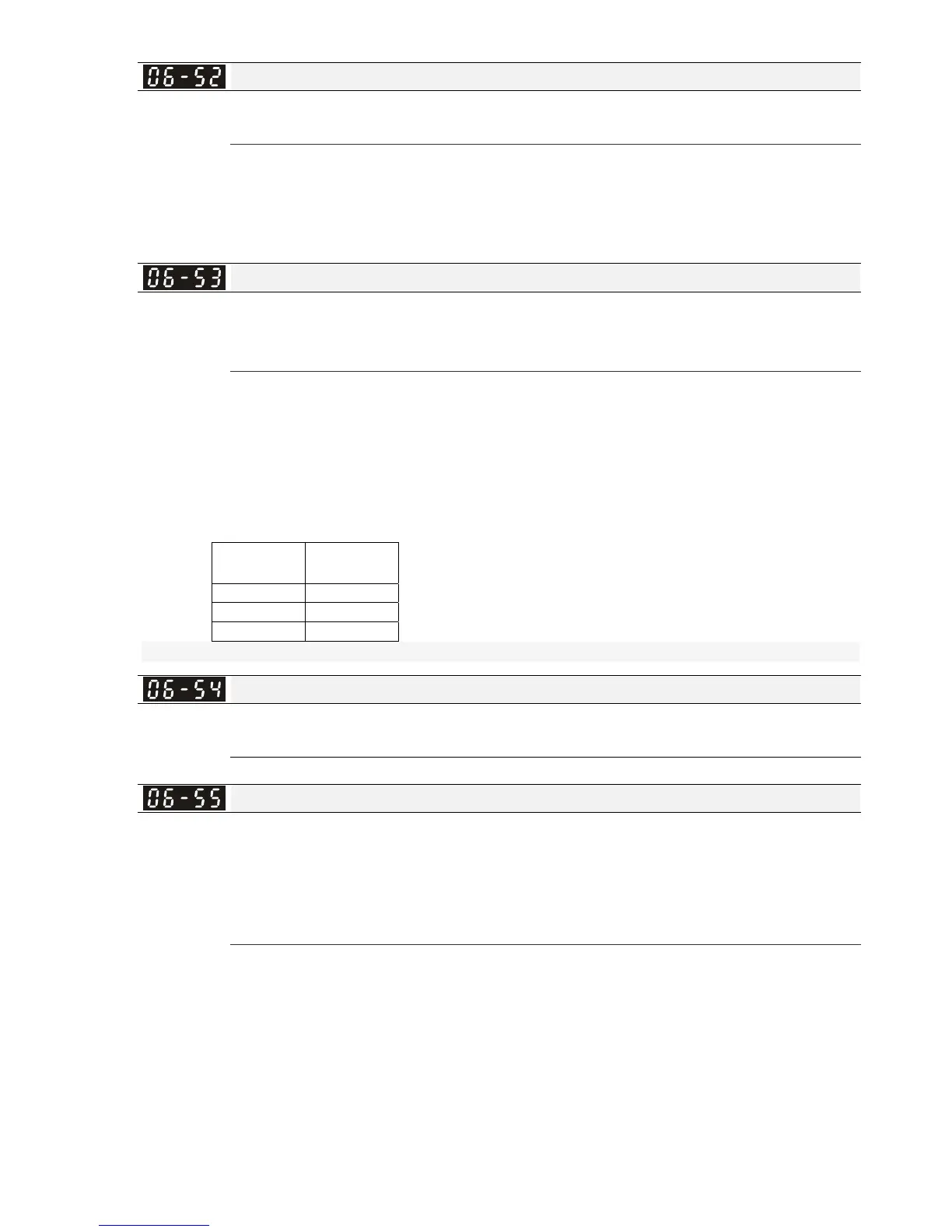
(I)% is
rated current percentage
(I)%
Actual
seconds
50 432
75 225
120 60
When any condition is not satisfied, the ORP protect function will be recalculated.
Fault Code Record Index
Factory Setting: read only
Settings 0~6
Derating Protection
Factory Setting: 0
Settings 0: constant rated current and limit carrier wave by load current and
temperature
1: constant carrier frequency and limit load current by setting carrier wave
2: constant rated current(same as setting 0), but close current limit
Setting 0:
When the rated current is constant, carrier frequency (Fc) outputted by PWM will auto
decrease according to surrounding temperature, overload output current and time. If overload
situation is not frequent and only cares the carrier frequency operated with the rated current for
a long time and carrier wave changes during short overload, it is recommended to set to 0.
Refer to the following diagram for the level of carrier frequency. Take VFD007C43A in
normal duty as example, surrounding temperature 50oC with independent installation and UL
open-type. When the carrier frequency is set to 15kHz, it corresponds to 72% rated output



 To Next Page