Parameter/display Value range Unit
Factory
setting =
Bold
Explanation
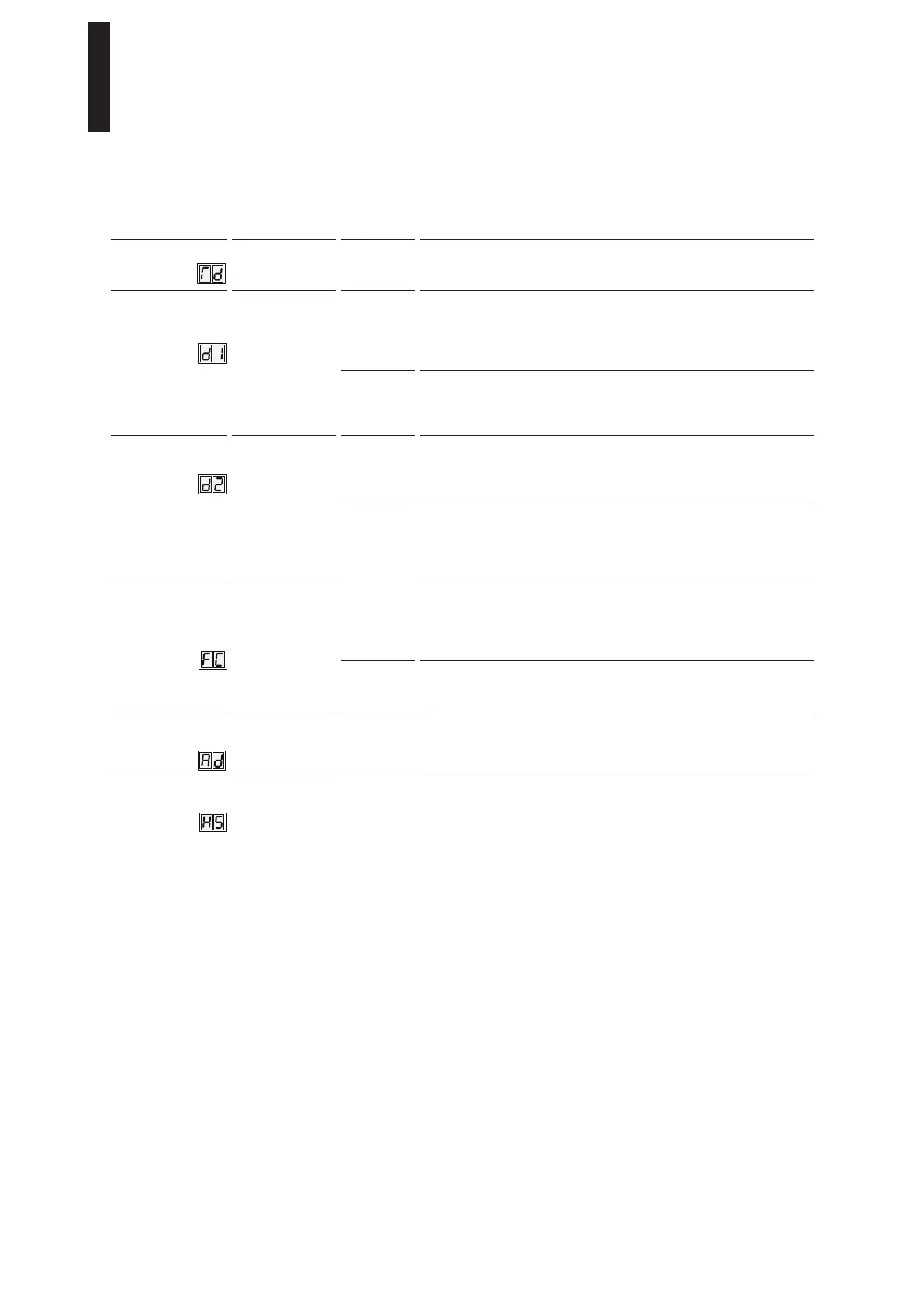
Door thickness 0 – 99 0...35...99
mm
The door thickness affects the measured door opening angle. If a
more accurate resolution is required, you can enter the actual door
width.
Shutdown drive
function effective
direction
0 – 1
0
Normally closed contact
In case of a normally closed contact, the drive function will be shut
down. This effective direction must be used for door lock switches
which are equipped with a changeover contact or normally open
contact.
1 Normally open contact
In case of a normally open contact, the drive function will be shut
down. This effective direction must be used for door lock switches
which are equipped with a normally open contact.
Night/bank
effective direction
0 – 1
0
Normally open contact
The night/bank function will be triggered in case of a normally open
contact. This effective direction is preferred for a key switch button or
access control.
1 Normally closed contact
The night/bank function will be triggered in case of a normally closed
contact.
This effective direction is often used for the connection to an RWA or
GLT system in order to activate doors with a normally closed contact.
Triggering the
hold-open system
by disengaging the
door panel
0 – 1
1
Function switched on
If the drive is operated as a hold-open system, the manual triggering
can be carrried out via the manual closing of the door panel by 10°
(+/– 2°) from the taught hold-open time. A manual release button is
not required.
0 Function switched off
If the drive is operated as a hold-open system, a manual release
button will be required for the manual activation.
Castor angle for
2-panel doors
0 – 30 0...30° Here you can adjust the angle the active panel has to travel before the
inactive panel begins to open.
Clearance between
hinges
+ 5 – – 5
3
The clearance between hinges is crucial for the calculated door angle.
It may only have a small effect but it can be adjusted in extreme
cases to increase the accuracy.
The basic setting of the parameter HS is 3, for 30 mm.
In case of center-pivoted doors, the setting must be changed to the
negative. A teach-in run is then required as the system creates an
angle table as a function of the set parameters.
ED 100, ED 250
—
40



 To Next Page