D-FL 200 / Rev. 6 32
______________________________________________________________________________________________________
Industrie Elektronik GmbH & Co KG
- The vertical strike displays the trigger point for the measurement.
-
The no-signal-noise is measured in the first 100 values of the selected time frame of 512 values. If
the no-signal-noise is big enough you can recognise it in the picture (Fig. 25) Fourth page / Signal,
page 31. So, the evaluation takes place in the first fifth of the displayed chart.
11. Error Messages
Essential functions are monitored by the system itself. Errors are indicated in the display by the
messages “E.01” to “E.33”. If an error is detected, the relay “Error“ is not in operation position. The
relay “Error” is only in operation if no “Error” is occurred.
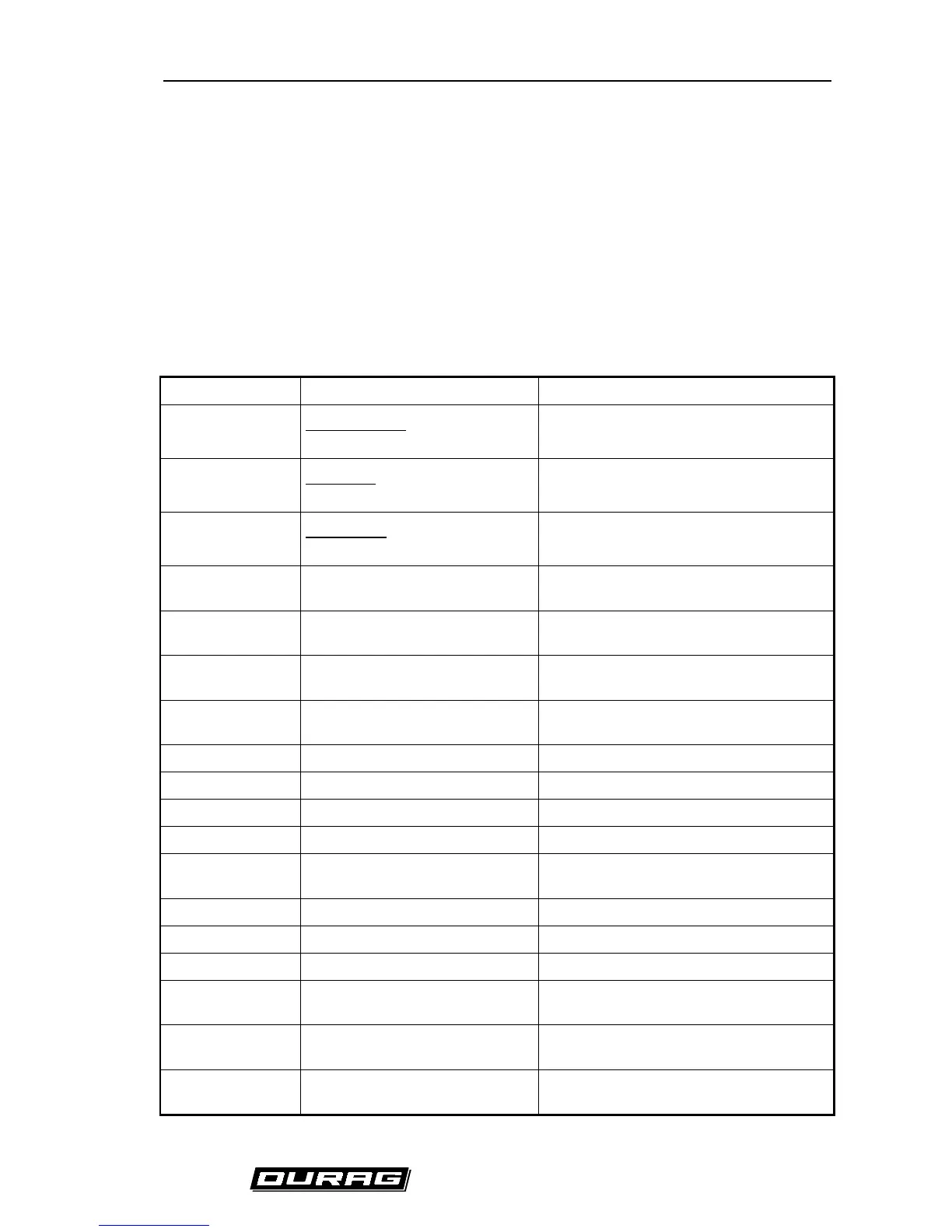
Error Message Type of Error Remedy
E.01 EEPROM-Error
Error in the input storage
Power up the system again; contact
DURAG customer service if necessary
E.02 RAM-Error
Error in the working memory
Power up the system again; contact
DURAG customer service if necessary
E.03 PROM-Error
Error in the program memory
Power up the system again; contact
DURAG customer service if necessary
E.04 Temperature transmitter lower
than 3,6 mA
E.05 Pressure transmitter lower than 3,6
mA
E.06 Temperature transmitter higher
than20 mA
E.07 Pressure transmitter higher than
20 mA
E.08 Sensor A is not transmitting Check sensor and connections
E.09 Sensor B is not transmitting look at E.08
E.10 Sensor C is not transmitting look at E.08
E.11 Sensor D is not transmitting look at E.08
E.12 Sensor A signal distorted Check transducer, increase amplification if
necessary
E.13 Sensor B signal distorted look at E.12
E.14 Sensor C signal distorted look at E.12
E.15 Sensor D signal distorted look at E.12
E16 Transducer A is not receiving a
sufficient signal
Check transducer, increase amplification if
necessary
E.17 Transducer B is not receiving a
sufficient signal
look at E.16
E.18 Transducer C is not receiving a
sufficient signal
look at E.16



 To Next Page