Dynatron® 850plus & 550plus
IFC & PREMOD - General Information
70
Interferential and Premodulated Therapy
Interferential (Quadpolar) Therapy
Interferential therapy uses four electrodes to
deliver two currents, one current with a
constant frequency of 4000 Hz and the other
current with a variable frequency of 4,001 to
4150 Hz. The paths of these two currents
cross resulting in a “beat” that produces the
therapeutic frequency at the treatment site.
The resulting frequency is between 1 and 150
Hz. An example of wave forms representing
these currents is illustrated here.
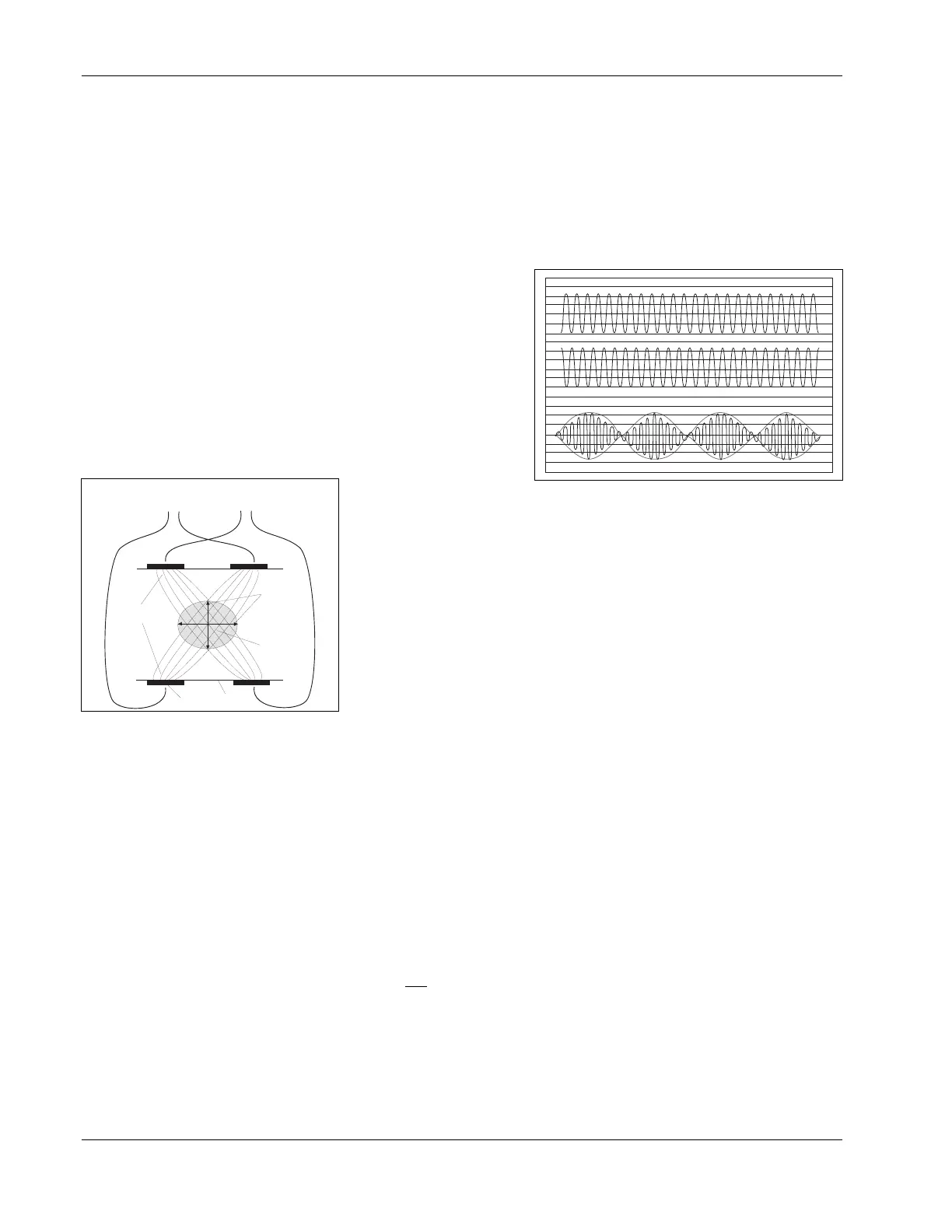
In the interferential
mode, two output jacks
(Channels 1 and 2) are
utilized with four
electrodes placed in a
criss-cross fashion, “bracketing” the treatment site as shown in the
illustration to the left. The output from Channel 1 is the constant
4000 Hz wave, while the output of Channel 2 is the variable 4000 to
4150 sine wave.
Premodulated (Bipolar) Therapy
Premodulated therapy utilizes one output jack and two electrodes. The current delivered is a
composite wave form. In order to produce this composite current, two frequencies are
“mixed” within the device prior to output. One frequency is 4000 Hz while the second
frequency covers a range between 4000 to 4150 Hz.
With the Dynatron 850plus and 550plus, either of the two channels may be used
simultaneously to deliver two separate, independent premodulated treatments. A criss-cross
electrode setup pattern should not
be used when setting up multiple premodulated treatments.
Note that a premodulated treatment usually requires a lower intensity setting than an
interferential treatment since current is dispersed to only two electrodes rather than four (a
smaller total dispersement area means greater current density at the treatment site).
The “beat” phenomenon. Two waves of
different frequencies over 4000 Hz, combine to
produce a beat which is between 1 and 150 Hz.
CHANNEL 1
CHANNEL 2
4001 - 4150 Hz
4000 Hz
Electrode
Skin Surface
High stimulation
intensity
where currents
cross
Area of low
stimulation
intensity
Direction of
stimulation
Stimulation produced by 4 electrodes.



 To Next Page