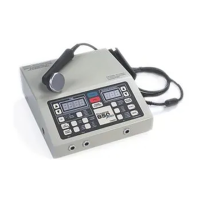
Dynatron® 850plus & 550plus
General Information - BIPHASIC & RUSSIAN
73
Russian / Biphasic Therapy
Russian Stimulation
With the Dynatron 850plus and 550plus’ Russian stimulation mode, the output of the device
is a 2500 Hz sinusoidal wave. Russian stimulation currents produce strong muscle
contractions.
The Dynatron 850plus and 550plus allow you complete control over all the parameters of the
Russian Stimulation treatment. Three treatment modes include Normal for firing one muscle,
Reciprocal for firing two different muscles at different times, and Co-contraction for firing
two different muscles simultaneously. The Dynatron 850plus and 550plus allow you to
choose a muscle contraction/relaxation cycle from options of 10/10 (ten seconds on and ten
seconds off), 10/30, 10/50, or continuous cycle. (The continuous duty cycle is not
recommended for electrical muscle stimulation, but may be used for settings that are intended
to effect other results than a muscle contraction.) In addition, you can modify the pulse rate,
the pulse width, and the ramp time.
The Normal mode requires use of just one output jack (Channel 1 or 2). The Reciprocal and
Co-Contraction modes utilize both channels 1 and 2.
Biphasic Stimulation
The biphasic stimulation feature is similar to Russian stimulation in the parameters that are
selected and in the available options. It differs from Russian stimulation in the pulse width
and rate ranges. Additionally, the biphasic pulse includes just one cycle (including one
positive phase and one negative phase) per pulse.
Biphasic / Russian Parameters
The Dynatron 850plus and 550plus offer even greater control over the Russian and biphasic
stimulation treatments through customization of the pulse rate and the pulse width. The
default settings and the available ranges for each of these are as follows:
Biphasic Stimulation:
Default Setting Valid Range
Pulse Rate 50 Pulses per second 1 to 500
Pulse Width 200 µSec 50 to 400 µSec
Russian Stimulation:
Default Setting Valid Range
Pulse Rate 50 Pulses per second 1 to 500
Pulse Width 10 mSec .4 to 50 mSec (depends on Pulse Rate)
The pulse rate and width should not be confused with the contraction/rest times in the
treatment as these are different parameters; the pulse occurs only during the contraction time.
The diagrams below illustrate the relationship of each of these parameters.



 To Next Page