B753-03-880 Issue F
Page 20 © Edwards Limited 2008. All rights reserved.
Edwards and the Edwards logo are trademarks of Edwards Limited.
Installation
3.3.5 Backing connection
Use suitable vacuum tubing and connectors to connect the NW flange of the backing-port to your backing-pump. If
necessary, use flexible pipe or bellows to reduce the transmission of vibration from the backing-pump to the EXT
pump.
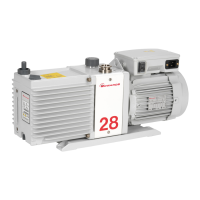
We recommend that you use an Edwards RV backing-pump. The backing-pump can also be controlled by the EXC
Controller (EXC120 EXC300). The minimum size of the backing-pump required is given in Table 1. You may have to
use a larger backing-pump if you run the pump at a high inlet pressure or high throughput, or if you purge the pump
with more than 25 sccm (0.42 mbar l s
-1
, 42 Pa l s
-1
) of purge gas. The EXT255H is also suitable for use with diaphragm
backing-pumps although the effect of high backing pressure on the pump’s performance and cooling requirements
should be noted (see Table 1 and Section 3.7).
Do not use the EXT pump with a backing pressure below 5 x 10
-4
mbar (5 x 10
-2
Pa). Lower backing pressures will
increase the evaporation rate of the lubricating oil and so will reduce the life of the bearings.
3.3.6 Interstage connection (EXT255Hi/EXT255HVi only)
The EXT255HVi pump is supplied with an interstage-port seal, and the EXT255Hi pump is supplied with a combined
inlet-strainer/interstage-port seal; leave the inlet-strainer in the interstage-port, unless you are sure that debris
cannot be drawn into the interstage-port.
Use the seal supplied and suitable vacuum tube and connectors to connect the interstage-port to your vacuum system
or to the outlet flange of another turbomolecular pump (if you use the EXT255Hi or EXT255HVi pump to back another
turbomolecular pump).
3.4 Vent-valve connection and control
When you design your system and when you install a vent-valve, take note of the information in Section 1.3 and 2.3.
You can vent the EXT pump and your vacuum system by any of the following methods:
z Use the manual vent-valve supplied. Take care not to open the manual vent-valve too quickly.
z Use a TAV5 or TAV6 solenoid vent-valve accessory (see Section 7) in place of the manual vent-valve.
z Use a TAV5 or TAV6 solenoid vent-valve connected to a convenient flange on your vacuum system.
z Use an alternative valve connected to your vacuum system.
If you use the manual vent-valve, you must open the vent-valve only after the EXT pump speed has fallen to 50% of
full rotational speed.
Do not vent from the backing line. If you vent into your vacuum system, select a point upstream of the pump, to
prevent oil backstreaming from the backing line.
If you use the TAV5 or TAV6 vent-valve we recommend that you control it from the EXC controller.
Table 3 gives an indication of the appropriate orifice size to be fitted to the vent valve for given vacuum system
volumes in order that the vent rate is kept within the limits given in Section 2.3.
Table 3 - Vent-restrictor orifice diameter (with atmospheric pressure at the inlet of the vent-valve)
Vacuum system volume (l) Orifice diameter (mm)
< 20 ≤ 1.0
< 10 ≤ 0.7
< 5 ≤ 0.5
< 2 ≤ 0.35


 To Next Page