B753-03-880 Issue F
Page 2 © Edwards Limited 2008. All rights reserved.
Edwards and the Edwards logo are trademarks of Edwards Limited.
Introduction
1.2 General description
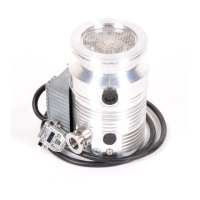
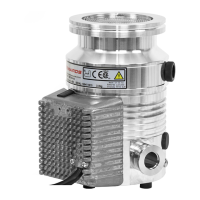
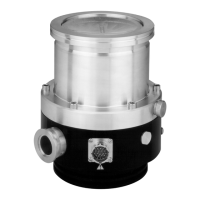
The EXT255H, EXT255Hi and EXT255HVi pumps are compound vacuum pumps that combine a turbomolecular pump
and a drag pump on a single shaft. Refer to Figure 1 and 2, which show the internal structures of the EXT255H and
EXT255HVi pumps.
The turbomolecular pump is made from a multi-stage axial-flow turbine which is optimised for operation in molecular
flow conditions. The drag pump is made from pumping channels formed by helical grooves. The drag pump is designed
for operation at higher pressures than conventional turbomolecular pumps.
The light alloy rotor (13) is machined from one piece to form the angled blades of the turbomolecular pump. The
rotor blades rotate between angled stator blades (12) which are supported by spacer rings (11). The rotor and stator
blades have an open structure at the pump inlet, and a more closed structure at the outlet. This configuration gives
an optimum combination of pumping speed and compression when pumping gases of both high and low molecular
weight. For the blades to be effective, their speed must be close to the thermal velocity of the gas. The rotor
therefore rotates at up to 60000 r min
-1
.
Gas from the inlet is compressed through each of the bladed stages of the turbomolecular pump and transferred to
the drag pump. In the drag pump stages, the gas is further compressed as it is pumped around the channels formed
by the helical grooves.
The rotating assembly is supported at the inlet end by a frictionless magnetic bearing (3) and by a precision ceramic
ball bearing (8) at the outlet end. The ball bearing is lubricated from an oil reservoir and wick mechanism (9).
All of the pumps are supplied with an inlet-screen (2) fitted in the bore of the inlet-flange. The EXT255Hi pumps are
also supplied with an inlet-strainer which fits in the interstage-port. The inlet-screen and inlet-strainer protect the
pump against damage which would be caused by debris which enters the pump. The inlet-screen also protects you
from the sharp blades in the pump.
All of the pumps have a vent-port you can use to vent the pump and your vacuum system to atmospheric pressure.
The vent-port introduces vent gas part way up the pump rotor; this ensures maximum cleanliness. The pump is
supplied with a manual vent-valve fitted to the vent-port. As described in Section 3.4, you can replace the manual
vent-valve with a TAV5 or TAV6 solenoid-operated vent-valve (available as an accessory: see Section 7).
All of the pumps have a purge-port (Figure 4 or 5, item 3) in the motor and bearing housing chamber. In order to
protect the bearing lubricant from the effects of high oxygen concentrations, you can introduce an inert purge gas
through the purge-port. You can fit an optional vent-port adaptor and purge restrictor to the purge-port to control
the flow rate of the purge gas and to filter the gas supply (see Section 7).
The EXT255Hi pump has an interstage-port, between the turbomolecular and drag pump. You can use the interstage-
port to pump a separate chamber of your vacuum system or to back another turbomolecular pump. If the pump
operates with an outlet pressure of less than 5 mbar (500 Pa) and an interstage inlet flow of less than 70 sccm
(1.17 mbar l s
-1
, 117 Pa l s
-1
), the vacuum performance at the turbomolecular pump-inlet is independent of the
interstage operating conditions.
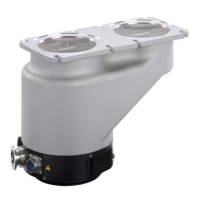
The EXT255HVi pump also has an interstage-port (14). The interstage-port is located in the turbomolecular pumping
region of the pump and, together with the higher conductance provided by the larger size interstage-port, enables
higher interstage pumping speeds than the EXT255Hi.
Electrical connection between the EXT and the EXC Controller is by a 19-way connector and a pump-to-controller
cable. The cable is a separate item and is available in a choice of lengths (see Section 7 for details). If you use an
EXC100L controller it is not necessary to buy a separate cable.
The pump may be cooled using air-cooled or water-cooled optional accessories. Refer to Section 3 for guidance on
applications and cooling requirements. Pumps with a Conflat flange are supplied with a water-cooler.
All EXT pumps have thermal sensors to monitor the motor and pump-body temperature.


 To Next Page