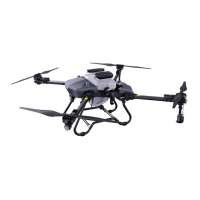
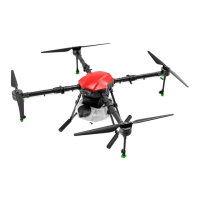
Regular maintenance ensures that the device performs at its best in future operations with fewer
malfunctions and improved efficiency. Maintenance steps are as follows:
A. Drone frame
①Check if any screw on the frame is loosening or missing.
②Check if the components including landing gears, fuselage, arms, motors and antennas are in
good condition.
③Check if the connectors of each component are firmly in position, whether they have oxidized,
and if the battery plug is deformed.
④Check breakages and cracks on the frame and components. Check if the beams of the aircraft
are bent out of shape or broken, if the fasteners joining the arms and motors together are secure,
if the arms are bent and twisted, or if the locking handle is intact.
⑤Clean the aircraft regularly and thoroughly, especially those hard-to-clean spots including the
liquid tank socket and battery plug on the frame.
B. Propulsion System
(1) Propellers
①Check if propeller clamps are cracked or deformed and if the blades are loosening, damaged,
bent out of shape or softened.
②Check if the blades and clamps are properly joined.
③Check if the setscrews holding the clamps and motors are missing or loosening.
④Wipe the propellers clean with a damp rag.
(2) Motors
①Remove the propellers and clean the motors with an air blow gun.
②Rotate the motors and check whether the bearings wobble or make noise.
③Check if the enameled wires of motors are broken.
④Gently rock the motors and see if they are firmly fixed on the motor mounts.
⑤Check the connectors and cables between motors and ESCs.
(3) ESCs
①Remove the power plugs of the ESCs and check if the metal parts are deformed or oxidized.
②Check if the setscrews on the ESCs are missing or loosening.
③Check if fouling such as pesticide deposits occurs in the heat dissipation part of the ESCs.
C. Spray System
The spraying system needs to be calibrated once it has a large error (outside of plus or minus



 To Next Page