ELAD FDM-DUO User Manual - Rev. 2.3 - 06/2016
© 2016 ELAD S.r.l. All rights reserved. No part of this document may be reproduced, published, used, disclosed or disseminated in any form or
by any means, electronic, photocopying or otherwise, without prior written permission of ELAD S.r.l.
5
1 Overview
1.1 Notice
Amateur radio regulations vary from country to country. Check your local amateur radio regulations and
requirements before operating the ELAD FDM-DUO.
1.2 Firmware versions
The features described in this manual refers to the following firmware versions :
Ver. 1.29
Date: 03/17/2016
Ver. 1.28
Date: 06/06/2016
Ver. 4.63
Date: 06/06/2016
Ver. 4.09
Date: 05/28/2015
Ver. 2.00
Date: 07/30/2014
1.3 Introduction
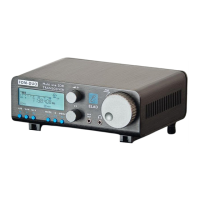
Thank you for choosing the FDM-DUO. It is an innovative dual mode SDR (Software Defined Radio)
transceiver covering the frequency range from 9kHz to 54MHz. The FDM-DUO can be used like a
standard transceiver in stand-alone mode or in remote mode to exploit the full potential of the ELAD
FDM-SW2 software. The FDM-DUO can still be connected to the FDM-SW2 software when it works in
"stand-alone" mode.
NOTE: For detailed information about ELAD FDM-SW2 software refer to user manual available at
http://sdr.eladit.com/FDM-sw2 20Software/Doc/
1.3.1 Main Features
Reception frequency range: 9kHz to 54MHz in direct sampling mode.
Transmission bands: 160m to 6m.
Selectable output power of 5W or 0dBm RF Out connector.
Double antenna connectors (RTX for single antenna use or RX/TX for separated antenna use).
Operating modes: CW, CWR, LSB, USB, AM and FM.
ADC Linear LTC2165,16bit @122.88MHz.
FPGA Spartan 6 XC6SLX25 + Serial Flash for stand-alone mode.
Stand-alone RX demodulator with STM32F4 ARM floating point μController.
LPC1766 Cortex M3 for LCD & Keyboard control.
TX modulator with STM32F4 floating point μP + AD9957 DDS @368.64 MHz.
Clocking source Si5338 driven by 10MHz TCXO or external reference input.
TX modulator from I2S source: MIC using Cirrus CS5346 or USB integrated Codec (CM6510B
codec with customized firmware).
CAT USB interface with FTDI controller.


 To Next Page