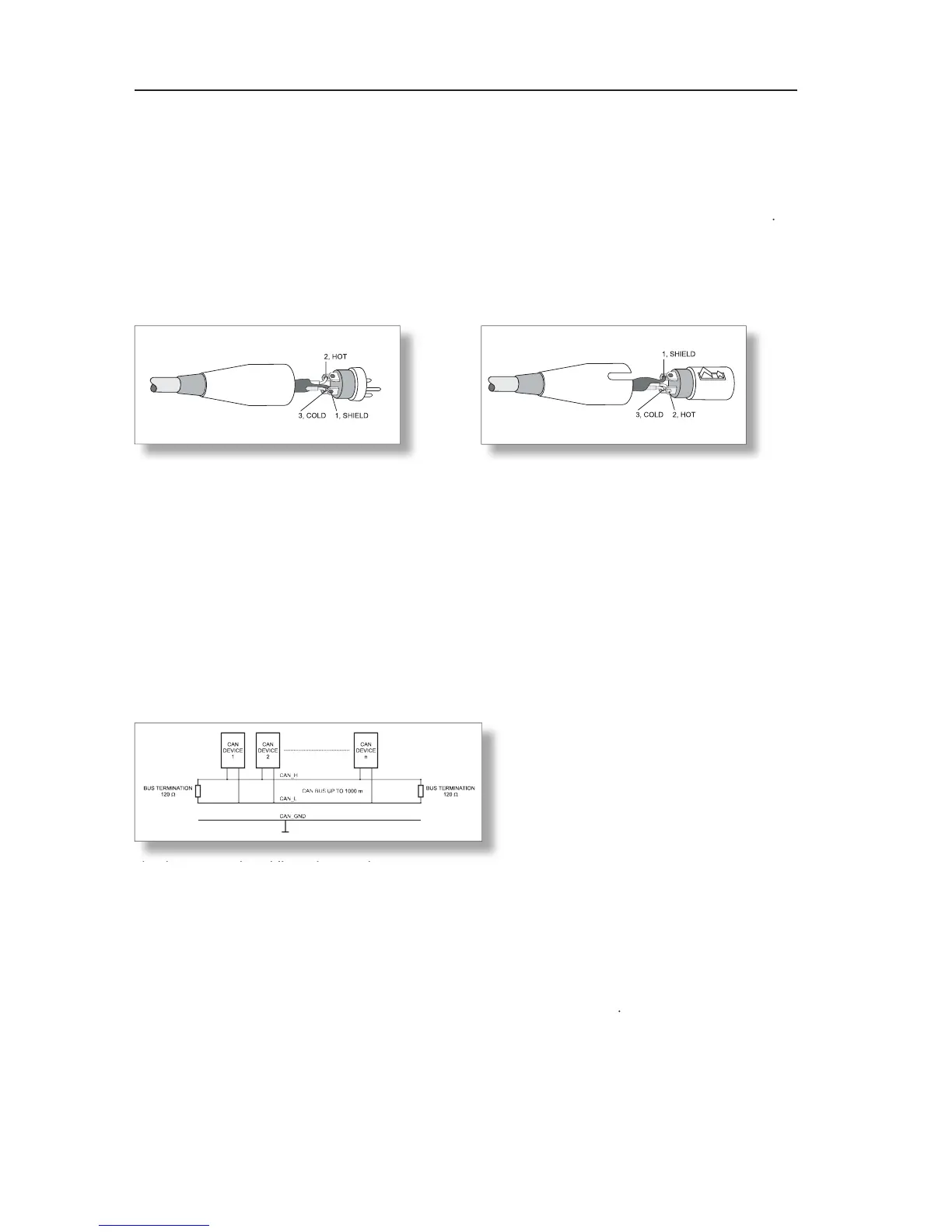
Choosing balanced cables (two conductors for the audio signal plus separate shielding mesh) with
XLR-type connectors is recommended for LF-signal connection. Although connecting unbalanced
cables to the power ampli er inputs is possible as well, using balanced cabling is always preferable. A
great number of today’s audio appliances employ balanced outputs. With balanced cabling, the shield
connects all metal enclosure parts and thus ef ciently eliminates the introduction of noise and hum
XLR-type connector pin-assignment
The network of the remote power amps is based on the CAN-bus standard, which for years is especially
popular in automotive, industrial and security applications. The CAN-bus is a balanced serial interface
for command and data transmission. Controlling the power ampli ers is performed from a PC with IRIS
– Intelligent Remote & Integrated Supervision – software installed. The UCC1 USB-CAN Converter
serves as interface between the PC and the CAN-bus. Connecting up to 100 power ampli ers per CAN-
Bus with a maximum total cable length of 1,000 meters is possible. An additional CAN-bus is needed
for controlling more than 100 power amps while the IRIS software allows administering a total of 250
The network topology used by the CAN-bus is based on the so-called “bus or line topology”, i.e. all
participants are connected via a single two-wire cable (Twisted-Pair cable, shielded or unshielded) with
the cabling running from one participant on the bus to the next, allowing unlimited communication among
all appliances. In general, it does not matter whether a participant on the bus is a power ampli er
or an UCC1 USB-CAN converter, so that
both – UCC1 and the PC as well – can be
inserted at any position. Incorporating several
UCC1 and PCs on a single CAN-bus is also
possible. A total of up to 100 appliances
can be operated on a single CAN-bus. Since
the CAN-interfaces of all appliances are
galvanically separated from the rest of the
circuitry, network cabling also carries a common ground conductor (CAN_GND) ensuring that all
CAN-interfaces in the network are connected to a common ground potential. The UCC1 provides the
possibility for switching the CAN-ground to circuit-ground.
Each participant on the bus system has two RJ-45 connectors for the Remote CAN-bus. These sockets
are connected in parallel to serve as input and output (for connecting through) for the data transfer within
the remote-network. The CAN-bus has to be terminated at both ends using 120
– are supplied with the UCC1. Connect one of these to the RJ-45 socket
of the rst and the other to the socket of the last appliance on the CAN-bus
circuitry, network cabling also carries a common ground conductor (CAN_GND) ensuring that all




 To Next Page