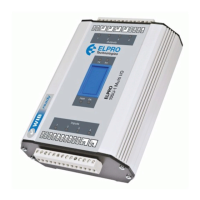
905U Wireless I/O Module User Manual
105S Serial I/O Module
Page 34 © January 2011
Canada, the 905U uses both sub-bands - but in other countries, only the high sub-band. In America
and Canada, it is possible to restrict the frequency hopping of the 905U to only the high or low band.
If there are many 905U systems in the same area, this technique will help to separate systems to avoid
radio interference. Note that this technique is only possible in America / Canada.
The radio sub-band can be selected by the “system address” - refer section 4 of this manual. An odd
system address selects the low band, and an even system address selects the high band.
Note that this section is not applicable to the fixed frequency 105U units.
3.2.3 Radio Path Reliability
Radio paths over short distances can operate reliably with a large amount of obstruction in the path. As
the path distance increases, the amount of obstruction which can be tolerated decreases. At the
maximum reliable distance, “line-of-sight” is required for reliable operation. If the path is over several
kilometres (or miles), then the curvature of the earth is also an obstacle and must be allowed for. For
example, the earth curvature over 5 miles (8km) is approx 10 feet (3m), requiring antennas to be
elevated at least 13 feet (4m) to achieve “line-of-sight” even if the path is flat.
A radio path may act reliably in good weather, but poorly in bad weather - this is called a “marginal”
radio path. If the radio path is more than 20% of the maximum reliable distance (see Specification
section for these distances), we recommend that you test the radio path before installation. Each
105U/905U module has a radio path testing feature - refer to section 6.2 and 6.3 of this manual.
There are several ways of improving a marginal path :-
• Relocate the antenna to a better position. If there is an obvious obstruction causing the problem,
then locating the antenna to the side or higher will improve the path. If the radio path has a large
distance, then increasing the height of the antenna will improve the path.
• Use an antenna with a higher gain. Before you do this, make sure that the radiated power from the
new antenna is still within the regulations of your country. If you have a long length of coaxial
cable, you can use a higher gain antenna to cancel the losses in the coaxial cable.
• If it is not practical to improve a marginal path, then the last method is to use another module as a
repeater. A repeater does not have to be between the two modules (although often it is). If possible,
use an existing module in the system which has good radio path to both modules. The repeater
module can be to the side of the two modules, or even behind one of the modules, if the repeater
module is installed at a high location (for example, a tower or mast). Repeater modules can have
their own I/O and act as a “normal” 905U module in the system.
3.2.4 Design for Failures
All well designed systems consider system failure. I/O systems operating on a wire link will fail
eventually, and a radio system is the same. Failures could be short-term (interference on the radio
channel or power supply failure) or long-term (equipment failure).
The modules provide the following features for system failure :-
• Outputs can reset if they do not receive a message within a configured time. If an output should


 To Next Page