DPSI RV Family Operating Instructions Version 2.0
Page 36 of 48
When using digital servos, it is very important to ensure that the heat
sink cools well.
Hint:
Depending on the number and power of servos being used the overall current
consumption of the system changes. The higher the overall current, the more
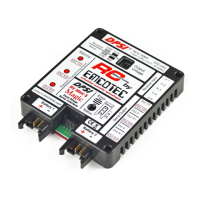
energy will be transformed into heat. The heat sink of the DPSI RV can therefore
become very hot. This is not a fault, but rather represents normal functioning.
Thus, sufficient heat dissipation must be provided for (clearance to neighboring
walls, such as fuselage sidewalls or the like; cooling air supply, if possible). When
the DPSI RV is fully equipped (more than 20 servos), it is possible to install an
additional heat sink.
Hint:
The assignment of the printed connections of the DPSI RV systems to the
receiver is to be understood as suggestions! The receiver channels can be
connected to arbitrary DPSI inputs. Thus, the receiver channel “1” can be put into
DPSI input “3”. Servo outputs 3 of the DPSI are then being driven by receiver
channel “1”. The assignment is therefore elective!
Safeguarding the servo connection cable:
Many pilots fear that the servo cables attached to the DPSI RV can
become loose from vibration and that this would then lead to a
malfunction. This type of occurrence has not yet been observed (not
even in the case of intense vibrations). Nevertheless, in order to
operate with maximum safety, each servo-cable inserted in the plug
can be safeguarded with a drop of hot-melt adhesive (or silicone
sealer) on the upper or lower edge of the housing. This has also been
proven in practice. This bond can also be easily broken.



 To Next Page