
 Need help?
Do you have a question about the Endress+Hauser Liquipoint T Series and is the answer not in the manual?
Explains the alternating voltage principle for level detection in conductive liquids.
Details the components of the measuring system: probes and control units.
Describes probes for one or two-point detection without integrated electronics.
Details probes for multiple point detection without integrated electronics.
Specifies measured variable, range, and input signal characteristics.
Details the FEW 52 electronic insert with PNP output and fail-safe modes.
Describes the FEW 54 electronic insert with relay output and its settings.
Explains selecting fail-safe modes for relay outputs (MAX/MIN).
Details the four settable measuring ranges for the relay output.
Covers the FEW 58 electronic insert for NAMUR standard output.
Provides wiring diagrams for the FEW 52 electronic insert.
Details the FEW 54 relay output circuit and protection.
Explains the FEW 58 NAMUR electronic insert and its signal transmission.
Wiring for two-rod/rope probes with cable monitoring.
Wiring for three-rod/rope probes with cable monitoring.
Wiring for five-rod/rope probes with cable monitoring.
Details M 20x1.5 and NPT 1/2" cable entry types.
Recommends using commercially available cable with specific resistance.
Details measuring error, repeatability, hysteresis, and temperature influence.
Covers mounting location and piping usage for probes.
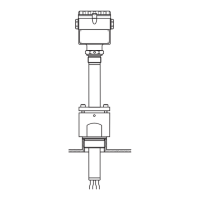
Shows mounting orientations and dimensions for rod probes.
Illustrates mounting orientations and dimensions for rope probes.
Depicts standard level limit detection scenarios.
Shows two-point control setup using the device.
Specifies ambient and storage temperature limits.
States climate class and IP66 degree of protection.
Covers vibration resistance and electromagnetic compatibility.
Shows temperature limits based on housing and medium temp.
Specifies minimum conductivity and permissible medium pressure.
Provides dimensions for rod/rope probes with G 1 1/2" connection.
Provides dimensions for rod/rope probes with NPT 1 1/2" connection.
Lists weights for different configurations of FTW 31 and FTW 32.
Details materials used for probes, housing, and covers.
Specifies dimensions and forces for rod probes.
Details diameter, lengths, insulation, and forces for rope probes.
Describes DIL switches for min/max, delay, and range settings.
Explains LEDs for fault and operation status on FEW inserts.
Confirms EC directive compliance, WHG, and leak test approvals.
Lists observed standards like low voltage, safety, and EMC.
Specifies ATEX Ex types and protection for FEW inserts.
Provides coding structure for ordering FTW 31 models.
Provides coding structure for ordering FTW 32 models.
Lists available accessories like lock nuts and electronic inserts (FEW 52, 54, 58).
Lists operating instructions and relevant certificates (WHG, ATEX).
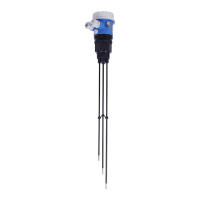
The Liquipoint T FTW 31 and FTW 32 are level limit switches designed for multiple point detection in conductive liquids, with conductivity starting from 10 µS/cm. These devices are suitable for various applications such as overspill protection, dry running protection, two-point control of pumps, and general multiple point detection within an existing process connection.
The measuring principle relies on an alternating voltage applied between the rod probes in an empty tank. When a conductive liquid connects the ground probe rod with a maximum probe rod, a measurable current flows, causing the Liquipoint T to switch. For level limit detection, the device switches back once the liquid clears the maximum probe. In two-point control, the Liquipoint T only switches back after both the MAX and MIN probes are cleared. The use of alternating voltage prevents corrosion of the probe rods and electrolytic destruction of the product. The system is designed as a closed, potential-free circuit between the probe rods and the electronics, making the tank wall material irrelevant for measurement. The probe rods are safe to touch during operation.
The measuring system can consist of FTW 31 or FTW 32 with two or three rods/ropes and an integrated electronic insert, or it can be a separate-instrument version without an integrated electronic insert, requiring connection to external control units like Nivotester FTW 325 or FTW 470 Z. The compact-instrument version with three probes or rods always operates in "As" mode. For multiple point detection, the separate-instrument version can accommodate up to five rods or ropes, requiring two Nivotester FTW 325 or FTW 470 Z units.
FEW 52 (DC-PNP):
FEW 54 (Relay):
FEW 58 (NAMUR):
 General
| Brand | Endress+Hauser |
|---|---|
| Model | Liquipoint T Series |
| Category | Accessories |
| Language | English |




 To Next Page