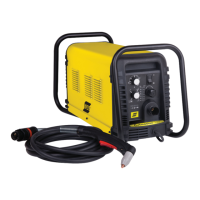
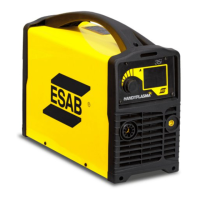
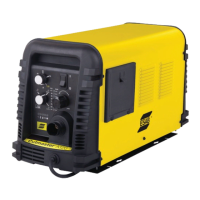
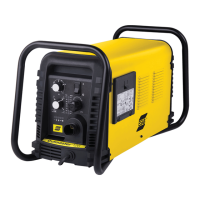
ESAB CUTMASTER 120
OPERATION Manual 0-5380
4T-6
7. Clean spatter and scale from the shield cup and
the tip as soon as possible. Spraying the shield
cup in anti - spatter compound will minimize the
amount of scale which adheres to it.
Cutting speed depends on material, thickness, and
the operator’s ability to accurately follow the desired
cut line. The following factors may have an impact on
system performance:
• Torchpartswear
• Airquality
• Linevoltageuctuations
• Torchstandoffheight
• Properworkcableconnection
4T.05 Gouging
!
WARNING
Be sure the operator is equipped with
proper gloves, clothing, eye and ear protec-
tion and that all safety precautions at the
front of this manual have been followed.
Make sure no part of the operator’s body
comes in contact with the workpiece when
the torch is activated.
Disconnect primary power to the system
before disassembling the torch, leads, or
power supply.
!
CAUTION
Sparks from plasma gouging can cause
damage to coated, painted or other sur-
faces such as glass, plastic, and metal.
Check torch parts. The torch parts must
correspond with the type of operation. Refer
to Section 4T.07, Torch Parts Selection.
Gouging Parameters
Gouging performance depends on parameters
such as torch travel speed, current level, lead angle
(the angle between the torch and workpiece), and
the distance between the torch tip and workpiece
(standoff).
!
CAUTION
Touching the torch tip or shield cup to the
work surface will cause excessive parts
wear.
Torch Travel Speed
NOTE!
Refer to Appendix Pages for additional
information as related to the Power Supply
used.
Optimum torch travel speed is dependent on current
setting, lead angle, and mode of operation (hand or
machine torch).
Current Setting
Current settings depend on torch travel speed,
mode of operation (hand or machine torch), and the
amount of material to be removed.
Pressure Setting
Even though the setting is within the specified range,
if the torch does not pilot well the pressure may
need to be reduced.
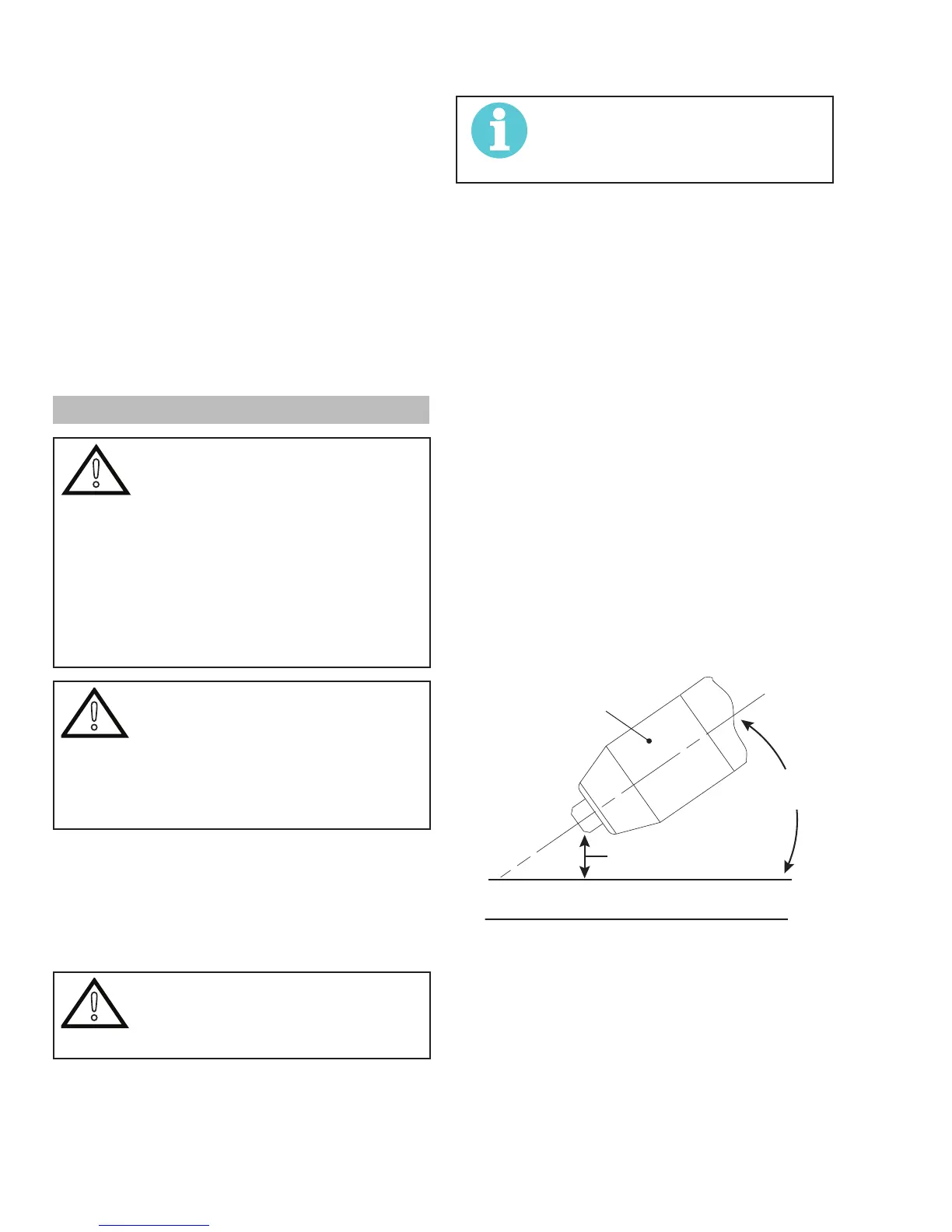
Lead Angle
The angle between the torch and workpiece de-
pends on the output current setting and torch travel
speed. The recommended lead angle is 35°. At a
lead angle greater than 45° the molten metal will
not be blown out of the gouge and may be blown
back onto the torch. If the lead angle is too small
(less than 35°), less material may be removed, re-
quiring more passes. In some applications, such
as removing welds or working with light metal, this
may be desirable.
35°
Workpiece
Torch Head
Standoff Height
A-00941_AB
Gouging Angle and Standoff Distance
Standoff Distance
The tip to work distance affects gouge quality and
depth. Standoff distance of1/8-1/4inch(3-6
mm) allows for smooth, consistent metal removal.
Smaller standoff distances may result in a severance
cut rather than a gouge. Standoff distances greater
than1/4inch(6mm)mayresultinminimalmetal
removal or loss of transferred main arc.


 To Next Page