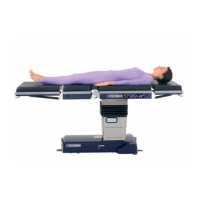
P8/54 T-SM47j
2.0 TECHNICAL DATA
2.1 Weights
The nominal weights of the standard table components
are listed below (for 50mm mattresses):
Leg section (without mattress) .. .. 11.50kg
Leg section mattress .. .. .. .. 2.75kg
Head section (without mattress) .. .. 7.75kg
Head section mattress .. .. .. 2.00kg
Table (base and column only) .. 192.00kg
Long and short trunk assembly* .. 55.75kg
Long and short trunk mattress .. .. 7.25kg
Total weight standard table .. .. .. 279kg
Lightweight leg section.. .. .. .. 4.50kg
Footrest (incl. mattress) .. .. .. 7.00kg
Width extender (incl. mattress) .. .. 6.00kg
Perineal instrument tray .. .. .. 3.00kg
* (without mattress)
2.2 Dimensions
The following are the nominal major dimensions of the
standard table (with head and leg sections fitted) and
include the 50mm mattress and side rails if applicable (see
Fig. 2.1 for illustration, the number in brackets after the
item details which part):
Overall length (2) .. .. .. 2102mm
Maximum height (4) .. .. .. 1120mm*
Minimum height (5) .. .. .. 720mm*
Maximum top traverse (2) .. .. 250mm
Overall width (6) .. .. .. 600mm
Sidebars (Denyer) .. .. .. 37.8 x 5.5mm
* 5mm less for Serial Numbers prefixed T2AA or T2AB
2.3 Movements
The following table movements are maximums and cannot
be assumed to be available in all combinations of table
positioning (see Fig. 2.1 for illustration, the number in
brackets after the item details which part). For example,
with the table in its normal configuration and at minimum
height the maximum Trendelenburg and leg section
movements cannot be achieved due to the proximity of
the floor. Similarly with a large amount of tilt set, maximum
Trendelenburg cannot be achieved.
Max. Trendelenburg (1) .. .. .. 35°
Max. reverse Trendelenburg (1) .. .. 35°
Max. extension (4) .. .. .. .. 230°
Max. flexion (4) .. .. .. .. .. 90°
Head section (5) .. .. .. .. ±45°
Leg section (3) .. .. .. .. -100° +55°
Max. lateral tilt (7) .. .. .. .. ±18°
2.4 Table loading
See maximum patient weight distribution charts in Fig. 2.2
and 2.3 for various table positions and orientations.
Maximum section loading is stated on each item and is
detailed below for reference:
Leg section .. .. 44kg
Head section .. .. 22kg
For accessories the maximum loading is stated on each
item and detailed in the User Handbook supplied with them.
For specific notes on the obese patient see the ‘Instructions
for Use’.
2.5 Electrical
2.5.1 Antistatic requirements
The table has an antistatic pathway from the table top,
through an internal resistor, to the castors.
CAUTION
To complete and maintain the antistatic
pathway the table must be used on an
electrically conductive or antistatic floor and
with mattresses supplied by Eschmann
Equipment.
2.5.2 Batteries
Table base:
Main batteries**:
Two, 12V 10.0Ah, sealed lead acid
Backup batteries**:
Two, 12V 1.2Ah, sealed lead acid
(see battery disposal caution in the ‘Instructions for Use’)
Infrared handset:
Two, 1.5V size AA Alkaline (Note: Must only be
changed in accordance with the notes in the section
6.6.19.2 to ensure the IP rating is not compromised).
2.5.3 Internal battery charger**
Input
100-240V a.c. 2.4A (max) 50-60Hz
Output
29.2V d.c. 2A (max.) when charge state LED
red or orange, 27.6V d.c. when charge state
LED green
2.5.4 Fuses
2.5.4.1
External fuses
Mains input fuses (item 17, Fig. 1.0)
2 x T4A (5 x 20mm) 250V
Battery fuses (item 8, Fig. 1.0)
2 x T20A (6.35 x 32mm) 500V


 To Next Page