T-SM47j P9/54
T20-a
OPERATION TABLE
Note: The right hand fuse is linked to the main batteries
and the left hand fuse (i.e. nearest to the backup battery
switch) is linked to the backup batteries.
Mains plug fuse
.. .. 10A (type is dependent on plug
which may have been changed from that originally
supplied)
2.5.4.2
Internal fuses**
(only accessible by engineer)
Battery fuses** (joining each battery pair)
2 x 30A blade type* (1 per battery pair)
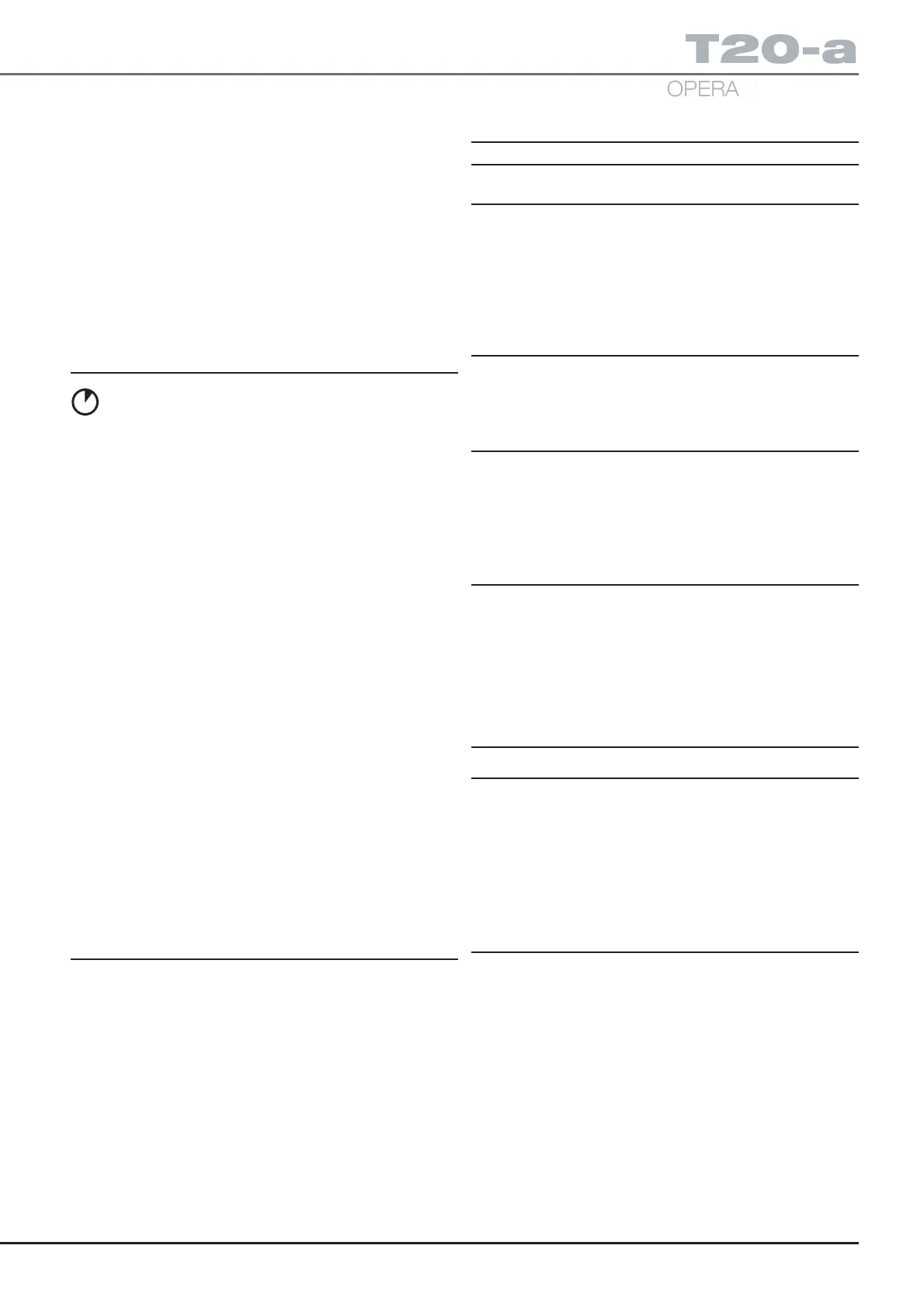
2.5.5 Duty cycle
This symbol is used to indicate the table’s duty cycle
which, in the worst case, is ‘60s : 600s’, the ratio of the
operating time to the sum of the operating time and the
ensuing interval (see note below). Each motor drive has
its own duty cycle and this is dependent on loading and
table position as detailed below.
Trendelenburg 1 : 4 (60s : 240s) at a maximum torque of
417Nm (e.g. 135kg load offset 31cm from the
fulcrum, or a 300kg load offset 14cm from the
fulcrum. Where this load is the patient and
accessories weight and the offset is how far the loads
centre of gravity is, from the centre of the column).
Traverse 1 : 4 (60s : 240s) when the table is
horizontal and at the maximum load of 300kg, or at
17.5° with a patient weight of 225kg, or at 35° with a
patient weight of 150kg.
Break 1 : 10 (60s : 600s) at maximum patient
weight of 300kg.
Height 1 : 4 (60s : 240s) at maximum patient
weight of 300kg (not offset).
Tilt 1 : 4 (60s : 240s) at maximum patient
weight of 300kg.
Note: The duty cycles above are all for the worst case (i.e.
maximum loads). For reduced loading the above duty
cycles can be increased.
2.6 Classification and symbology
All the symbols used on this table are shown and explained
in the ‘Instructions for Use’. These detail the safety category
and class of this table as marked on the table or section by
the use of these symbols.
2.7 Use in conjunction with other
equipment
2.7.1 Electrosurgical equipment (h.f.)
The T20-a operation table has been designed to minimise
the possibility of accidental electrosurgery burns and can
be used in conjunction with electrosurgical equipment.
However, contact with any metal surfaces (e.g. table side
bars, or other equipment etc.) can cause burns during
electrosurgery and must be avoided.
2.7.2 Defibrillation equipment
With the mains cord attached the equipment has
defibrillator proof applied parts with type BF protection
against electric shock.
2.7.3 Other
When the T20-a is used in conjunction with other infrared
controlled devices, their controllers should be checked to
ensure that no interference between them and the T20-a is
possible, prior to surgical intervention. Also see the
‘Instructions for Use’.
2.8 Standards compliance
The table has been designed and built to comply with the
following international standards:
BS EN 60601-1: 1990 (issue 2, October 1997)
BS EN 60601-1-2: 1993
BS EN 60601-2-46: 1998
BS EN 60601-1-4: 1997
2.9 Environmental conditions
2.9.1 Operating environment
The table has been designed to operate in the following
environment:
Temperature range .. .. 10°C to +40°C
Pressure range .. .. .. 69KPa to 106KPa.
Humidity range .. .. .. 30% to 75% RH
non-condensing.
2.9.2 Transport & storage environment
The table can be transported and stored safely, in the
following environment:
Temperature range .. .. -30°C to +50°C
Pressure range .. .. .. 69KPa to 106KPa
Humidity range .. .. .. 30% to 90% RH
non-condensing.
** NOTE: Items marked ** are to be changed with caution. During change or
replacement they must only be disconnected for a maximum of 60 seconds. If
battery power is removed from the table for longer than this then reconditioning
of the battery management system must be carried out, see section 6.6.26.


 To Next Page