4
4. Occupancy detection and its function
Occupancy detection systems are required in order to provide
information regarding the track status. A track can either be oc-
cupied or unoccupied.
This information is useful for parts of your layout that you cannot
directly see from your position (e.g.: storage yards) or if you wish
to display the track status on your track control diagram.
Occupancy feedback is an essential prerequisite for any partial or
fully automatic operation: the automated system respectively the
computer needs information in order to decide if a certain train
may enter a certain track or which route should be switched.
Furthermore modern occupancy detection systems can provide in-
formation about which vehicle is located in a certain track sector.
Subject to the track system and the application there are three
methods of how track occupancy can be determined.
4.1. Contact with the common conductor
The simplest form of feedback is to use reed contacts closing the
circuit to the common conductor, light barriers or photo sensors,
track contacts or track sections with integral switch contacts. With
the three-rail-system the occupancy detection is often realised by
insulating one outer track from the rest of the layout and thus use
it as an electrical switch. This corresponds with the well known
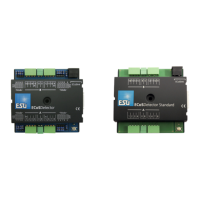
original “s88 configuration”. The ECoSDetector as well as the
ECoSDetector Standard support this mode.
4.2. Current sensors (not with ECoSDetector Standard)
With this method suitable for all track systems the detector mea-
sures the current flowing through the respective track sector. Every
electric load on the track causes a current flow. “A current flow” is
therefore equivalent to the “occupied” status of the track. There-
fore the status “there is no current flowing” means the track is
unoccupied.
All loads must draw a minimum current of about 1mA (0,001A)
in order to assure reliable operation of this current measuring
system.
Occupancy detection and its function
Commercially available resistor axles with about 18 kOhm can
just be detected provided the tracks are clean and the wheels sit
properly on the tracks. We recommend equipping two axles per
car with resistors. The resulting resistance value of about 9 kOhm
is reliably detected.
In case of an interruption of the track voltage (e.g.: due to a short
circuit or an emergency stop with power out) there will be no
current flow and occupancy detection is not possible any longer.
In order to prevent any incorrect “unoccupied” feedback to the
command station the occupancy status is frozen for the duration
of the power failure.
As soon as the track voltage is turned on again the occupancy
status is monitored and current information is transmitted to the
command station.
4.3. RailCom® feedback (not with ECoSDetector Standard)
Decoders equipped with RailCom® or RailComPlus® can provide
the locomotive number to the ECoSDetector which in turn will
transmit it to the command station. Finally we can determine pre-
cisely which locomotive is located on which track. The ECoSDetec-
tor must read the current flow in the track sector in order to read
out the RailCom feedback.


 To Next Page