38
Operation
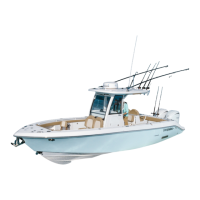
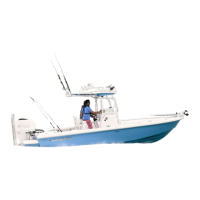
• Only operate the boat from the upper station
in familiar waters or where running aground is
not a possibility. Running aground while op-
erating the boat from the upper station could
result in severe injury.
• Always be alert for waves and boat wakes
when operating the boat from the upper sta-
tion. Remember that the boat’s motions are
exaggerated in the upper station.
• Good common sense and judgment must be
exercised at all times when operating a boat
from the upper station.
• If an engine alarm sounds, immediately put the
boat in NEUTRAL and shut OFF the engine(s),
if safe to do so, until the problem is found and
corrected.
• Always put the boat in NEUTRAL before mov-
ing to and from the upper station helm and
cockpit.
GOOD COMMON SENSE, JUDGMENT AND EXTREME
CAUTION MUST BE EXERCISED WHEN OPERATING A BOAT
WITH SOMEONE IN THE UPPER STATION. DO NOT ALLOW
ANYONE IN THE UPPER STATION WHEN THE WATER IS
ROUGH OR WHEN OPERATING IN UNFAMILIAR WATERS
WHERE RUNNING AGROUND IS A POSSIBILITY. REMEMBER,
WEIGHT IN THE UPPER STATION RAISES THE BOAT’S
CENTER OF GRAVITY AND THE BOAT’S MOTION IS GREATLY
EXAGGERATED FOR THE PEOPLE IN THE UPPER STATION.
2.13 Man Overboard
If someone falls overboard, you must be pre-
pared to react quickly, particularly when you are
oshore. The following procedures will help you
in recovering a person that has fallen overboard.
• Immediately stop the boat and sound a man
overboard alarm and have all passengers point
to the person in the water.
• Circle around quickly and throw a cushion or
life jacket to the person, if possible, and an-
other to use as a marker.
• Keep the person on the driver side of the boat
so you can keep him in sight at all times.
• Make sure to approach the person from the
downwind side and maneuver the boat so the
propellers are well clear of the person in the
water.
• Turn o the engines when the person is along-
side and use a ring buoy with a line attached, a
paddle or boat hook to assist him to the boat.
Make sure you don’t hit him with the ring buoy
or the boat.
• Pull the person to the boat and assist him on
board.
• Check the person for injuries and administer
rst aid if necessary. If the injuries are seri-
ous, call for help. Refer to the Safety chapter
for more information on rst aid and request-
ing emergency medical assistance.
MOVING PROPELLERS ARE DANGEROUS. THEY CAN
CAUSE DEATH, LOSS OF LIMBS OR OTHER SEVERE INJURY.
DO NOT USE THE SWIM PLATFORM OR SWIM LADDER WHILE
THE ENGINES ARE RUNNING. STOP THE ENGINES IF DIVERS
OR SWIMMERS ARE ATTEMPTING TO BOARD. ALWAYS
PROPERLY STORE THE LADDER BEFORE STARTING THE
ENGINES.
2.14 Water Skiing & Wakeboarding
Your boat could be equipped for water skiing and
wakeboarding. If you have never driven skiers
before, you should spend some hours as an ob-
server and learning from an experienced driver.
If you are an experienced driver, you should take
some time to become familiar with the boat and
the way it handles before pulling a skier. The
driver should also know the skier’s ability and
drive accordingly.
The following safety precautions should be
observed while towing water skiers.
• Water ski only in safe areas, away from other
boats and swimmers, out of channels and in
water free of underwater obstructions. The
area should be at least 5 feet deep, 3000 feet
long and have at least 100 feet between each
side of the boat and any obstructions.
• Make sure that anyone who skis can swim. Do
not allow people who cannot swim to water ski.
• Be sure that the skier is wearing a proper life
jacket. A water skier is considered onboard the
boat and a Coast Guard approved life jacket
is required. It is advisable and recommended
for a skier to wear a otation device designed
to withstand the impact of hitting the water
at high speed.



 To Next Page