13
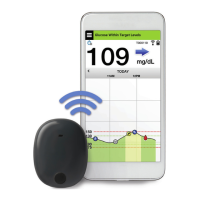
The system is intended to:
• Provide real-time glucose readings.
• Provide glucose trend information.
• Provide alerts for the detection and prediction of episodes of low blood glucose (hypoglycemia) and high blood
glucose (hyperglycemia).
The system is a prescription device. Historical data from the system can be interpreted to aid in providing therapy
adjustments. These adjustments should be based on patterns and trends seen over time.
The system is intended for single patient use.
MRI Safety Information
Non-clinical testing has demonstrated the Eversense Sensor is MR Conditional. A patient with this device can be safely
scanned in an MR system meeting the following conditions:
• Static magnetic field of 1.5T or 3.0T.
• Maximum spatial field gradient of 2000 gauss/cm (20 T/m).
• Maximum MR system reported, whole body averaged specific absorption rate (SAR) of 4 W/kg (First Level
Controlled Operating Mode).
Under the scan conditions defined above, non-clinical testing results indicate the Eversense Sensor is expected to
produce a maximum temperature rise of less than 5.4 °C after 15 minutes of continuous scanning.
In non-clinical testing, the image artifact caused by the device extends approximately 2.83 inches (72 mm) from the
Eversense Sensor when imaged with a gradient echo pulse sequence and a 3T MR system.
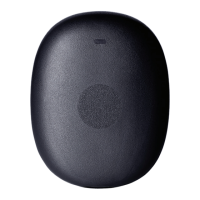
The Eversense Smart Transmitter is MR Unsafe and MUST BE REMOVED before undergoing an MRI procedure. Before
you undergo an MRI procedure, tell the MRI sta that you have an Eversense Sensor and Smart Transmitter.
LBL-1602-01-001 Rev N_Eversense User Guide_mgdL_R1.indd 13LBL-1602-01-001 Rev N_Eversense User Guide_mgdL_R1.indd 13 2/26/20 12:58 PM2/26/20 12:58 PM


 To Next Page