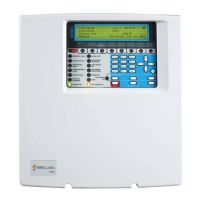
FireClass Panels and Repeaters Alarm operator actions
User Manual Doc. version 2.0 11
state by performing a fire reset. In accordance with VDS
2496, type B dependency is not permitted for the trig-
gering of fire extinguishing systems. In accordance with
VDS 2496, type B dependency is also not permitted in
combination with a manual call point.
2.7.5 Delays to outputs
The panel may be configured to delay the activation of
outputs to fire alarm devices, signalling, or protection
equipment. In accordance with VDS 2496, the delay to
outputs for sounders and signalling devices are not per-
mitted in combination with manual call points.
2.7.6 Alarm
The panel issues an alarm as follows:
The internal buzzer sounds continuously.
The red FIRE LED lights.
The (SOUNDERS) LED lights.
The (SIGNALLING) LED may light (see section
2.8.1 “Alarm investigate option“ on page 11).
The LCD displays the following information:
– The First Fire window shows the first fire to
occur, including details of the zone number and
description, and the point address.
– The Last Fire window shows the same informa-
tion, but is dedicated to the last zone that entered
alarm. This window is based on zone because it is
more important to know that a fire has spread to
another zone than to know that the fire has
spread to a second detector in the first fire zone.
To fulfil this requirement, the window updates to
show the last fire, but only if this is the first fire to
occur in its zone.
– The number of alarms is displayed at the right
hand side of line 5 in the fire window.
– There may be other event alerts that you can see
using the More (F5) key. For details see 2.8
“Alarm operator actions“ on page 11.
2.8 Alarm operator actions
This section gives options for responding to pre-alarm
warnings, alarm warnings, and alarms.
In an alarm situation, follow the local site procedures.
2.8.1 Alarm investigate option
In Day mode you can delay the fire brigade signalling
and the sounders. This gives you time to investigate the
alarm and cancel the signalling if you discover the alarm
is a false one. For full details see section 2.4 “Selecting
Day or Night mode“ on page 8.
There is no delay option, and the signalling and sound-
ers immediately activate, in these circumstances:
Night mode is active.
A call point is activated.
There is a sounder fault.
Investigating an alarm
1 When the alarm starts, check the (SIGNALLING)
LED. If this LED is lit, the signalling has already acti-
vated, so abandon this procedure.
2 Optionally silence the buzzer or sounders using the
SILENCE BUZZER and SILENCE/RESOUND con-
trol keys.
DANGER
In an alarm situation, inappropriate use
of the panel functions may lead to
death, serious injuries or damage to
property.
This guide includes step by step
instructions on carrying out operations
on the panel. However you must ensure
the operation is appropriate for the
circumstances, according to the local
site procedures.
DANGER
When investigating an area of a building
protected by a CO detector that has
raised an alarm, there is a particular
danger of fires not being detected,
leading to possible death, serious
injuries or damage to property.
This is because CO detectors are liable
to raise an alarm earlier than other types
of detectors, so as no other detectors
are in alarm you might dismiss this as a
false alarm. The CO detector may also
have alarmed before the fire is visible
(this applies particularly to fires in hard-
to-access areas, such as between tightly
packed materials or in cupboards and
storage rooms, or in areas far away from
the detector).
You should take care in your
investigation, and not clear an area as
being safe until you are absolutely sure.


 To Next Page