a positive effect upon antenna function. Users are advised not to
install the PowerFLARM unit within or under the instrument
panel cover.
If more than one GPS antenna is present, it is recommended that
they are at least 25 cm apart; the same holds good for separation
from the PowerFLARM communications antenna.
FLARM®-COMMUNICATIONS
The PowerFLARM radio communications are made using a
public frequency band known and requiring no user licence.
This means that the band is also used by a number of other
applications. FLARM has no exclusive rights to use the frequency
band, so there is no guarantee that FLARM reception will be free
from interference by other users.
The use of unlicensed bands by aircraft is subject to a number of
limitations, with some national differences. The pilot and user of
PowerFLARM are solely responsible for ensuring that the unit is
used in accordance with the current local regulations.
Essentially, the PowerFLARM communications protocol places
no limit on the number of units that may be contacted within the
working range. However, an increasing number of PowerFLARM
units within range leads to a reduction in the probability
('graceful degradation'), that a single signal report can be
received. But the probability that the next signal from the same
transmitter will not be received is generally small. PowerFLARM
is designed to simultaneously receive and process the signals
from more than 50 aircraft within radio range. A large number of
signals from other aircraft does not reduce the working range.
Transponder and ADS-B Reception
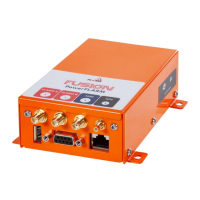
The ADS-B and transponder antennas are inserted and screwed
to the reverse-polarity SMA socket as marked. Make sure you do
not mistakenly insert the FLARM communications antenna in the
SMA socket, and do not use any force.



 To Next Page