PowerFLARM Manual Version 1.0
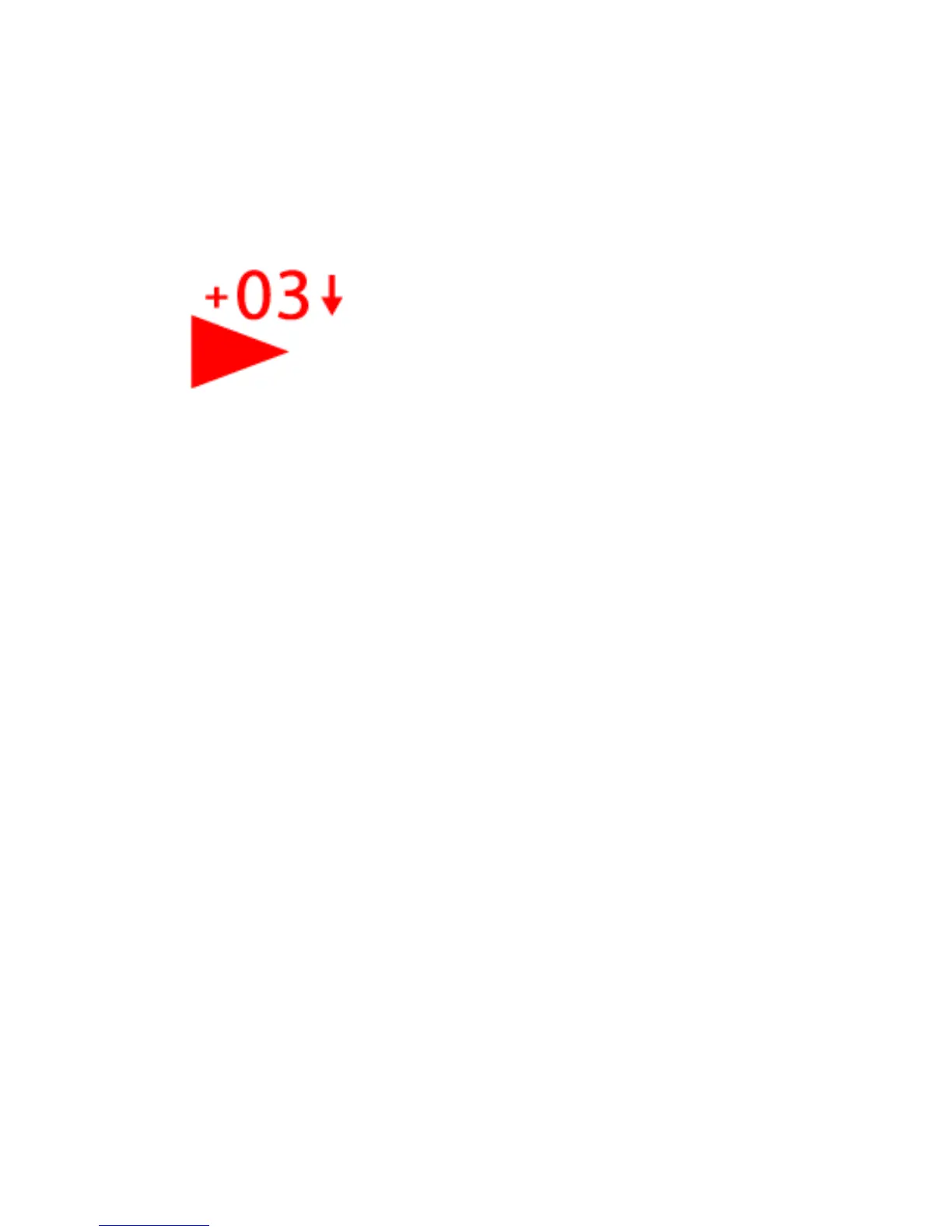
together with an indication of climb/descent.
In this example: 300ft higher, descending,
flying from left to right.
Very large red arrow: there is an immediate
threat of collision. In addition, the display
gives an indication of the vertical angle to the
other aircraft. The flight direction and height
difference of the other aircraft are given to
the nearest 100 ft, together with an
indication of climb/descent. In this example:
300ft higher, descending, flying from left to
right.
Information about Warnings
If there are several fixed or moving objects within radio range,
FLARM uses a mathematical algorithm to determine that which
poses the most immediate threat, and issues a warning about
this threat and none other. The pilot is unable to acknowledge
the warning. However, in spite of a warning having been given
for a single object it remains possible that several, or other
objects simultaneously represent a major threat, or in effect are
together more dangerous than the object for which the warning
was issued. If the unit simultaneously detects a threat from a
moving object and a fixed object, then a warning is issued for
that which represents the earliest threat of collision.
On the basis of calculation FLARM indicates the direction taken
by the most dangerous object, and its current location. FLARM
does not indicate where the closest proximity may occur, nor
what avoiding action is required. Whether and what avoiding
action should be taken is the sole responsibility of the pilot,
whose correct response must be based upon his own
observation of the local airspace. In particular, he must observe
the avoidance rules of the air, and ensure that the avoidance
action does not endanger any other airspace user. Depending
upon the flight phase, FLARM uses different forecast processes,
movement models and warning calculations to provide the pilot
with the best possible support without distraction. For example,
sensitivity is reduced when a sailplane is circling. These models



 To Next Page