Need help?
Do you have a question about the Fortis RC-400A and is the answer not in the manual?
A detailed list of all components included in the product package with their specifications.
Attaching the mounting plate to the main frame using specified hardware and tools.
Securing the front and rear stabilizers to the main frame using bolts and washers.
Assembling the handlebar post and connecting sensor and trunk lines.
Attaching the main handlebar to the handlebar post for user control.
Attaching the left and right pedals to the cranks, ensuring correct tightening direction.
Assembling the seat, seat post, and seat slider for user comfort.
Attaching the back pad and lower handlebar to the seat post.
Mounting the console, connecting wires, and moving the machine to its final location.
Turning on the computer, selecting programs, setting values, and understanding wake-up function.
Details on Time, Distance, RPM (p.17), Speed, Calories, Pulse, Age, and Target Heart Rate (p.18).
Explanation of the START/STOP, UP, DOWN, ENTER, BODY FAT, and PULSE RECOVERY keys.
Instructions for using the manual program, setting time, distance, calories, and pulse.
Overview of 12 preset programs with descriptions like Steps, Hill, Mountain, etc.
Guide for creating and customizing personal exercise profiles across 4 user slots.
Explanation of programs that adjust resistance based on heart rate zones.
Instructions for measuring body fat, BMI, and BMR using the dedicated program.
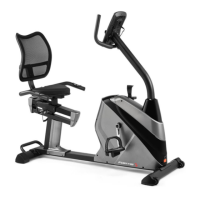
This document is a user guide for the Fortis Automatic Variable Resistance Magnetic Flywheel Recumbent Bike, model RC-400A (FSARCB400AA). It provides detailed instructions for assembly, operation, and safety warnings for the exercise equipment.
The Fortis RC-400A is an automatic variable resistance magnetic flywheel recumbent bike designed for indoor exercise. It allows users to engage in a low-impact cardiovascular workout while seated in a reclined position, which can be more comfortable and supportive for the back compared to upright bikes. The bike features a magnetic flywheel system that provides variable resistance, adjustable through the console. It includes a computer monitor that tracks various workout metrics and offers multiple preset and user-defined programs to customize the exercise experience. The recumbent design, along with adjustable components like the seat and handlebars, aims to provide a comfortable and effective workout for a range of users.
The recumbent bike offers a comprehensive set of features to enhance the user's workout experience:
The user guide outlines several maintenance recommendations to ensure the longevity and safe operation of the bike:
 General
| Brand | Fortis |
|---|---|
| Model | RC-400A |
| Category | Exercise Bike |
| Language | English |

 To Next Page