EasyManua.ls Logo

Fostex X-28 - Tape Sync

Fostex X-28
36 pages
Print Icon
To Next Page IconTo Next Page
To Previous Page IconTo Previous Page
Loading...
Example
3:
Tape
Sync
Tape
sync
is
the
process
of
using
one
of
the
tracks
on
the
X-28
to
synchronize
operation
with
a
MIDI
se¬
quencer,
which
in
turn
is
used
to
control
several
in¬
struments
simultaneously.
A
MIDI
sequencer
is
basi¬
cally
a
multitrack
performance
recorder,
that
allows
you
to
record
and
play
back
MIDI-compatible
instru¬
ments.
Using
tape
sync
with
a
MIDI
sequencer
offers
many
advantages:
MIDI-controlled
instruments
need
not
be
recorded
on
tape,
thus
freeing
up
track
space
for
acoustic
instruments
and
vocals.
Better
overall
sound
quality
is
achieved
when
the
MIDI-controlled
instruments
are
mixed
directly
to
the
master
recorder
during
mixdown.
Greater
production
flexibility
is
achieved
through
tape
sync
since
you
can
change
the
MIDI-recorded
musical
parts
and
even
the
sounds
(with
the
ex¬
ception
of
tempo)
right
up
until
the
final
mix.
Note:
Since
MIDI
signals
cannot
be
recorded
directly
onto
tape,
an
FSK-to-MIDI
converter
is
required.
This
device
converts
the
MIDI
clock
data
from
the
MIDI
sequencer
into
an
FSK
(Frequency
Shift
Keying)
signal,
which
is
then
recorded
to
tape.
In
playback,
the
FSK
signal
is
converted
back
into
MIDI
data
for
synchronization
with
the
sequencer.
Most
modem
sequencers,
rhythm
machines
and
MIDI
control
devices
have
these
FSK
circuits
built-in:
in
some
cases
you
may
need
to
purchase
an
external
converter.
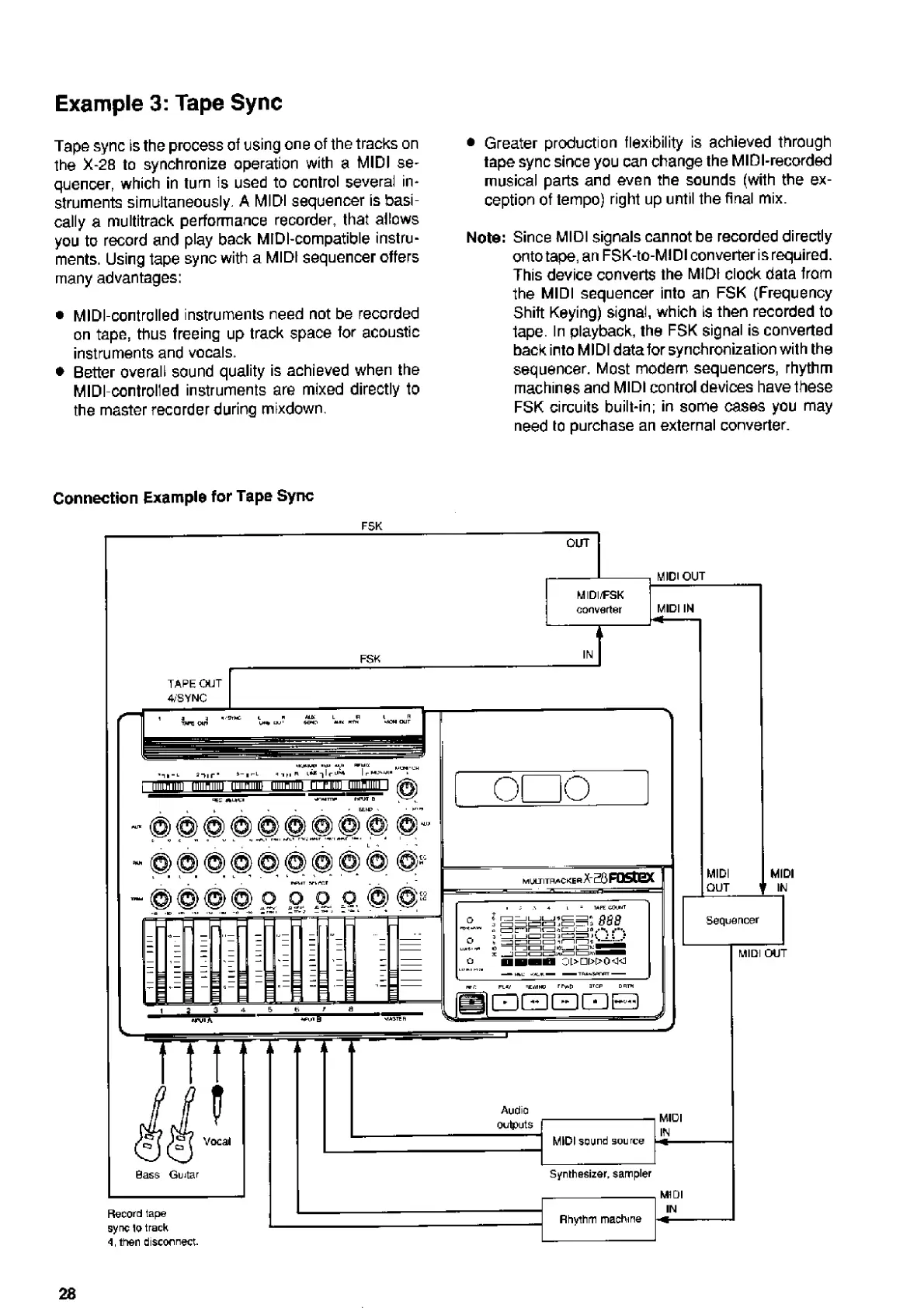
Connection
Example
for
Tape
Sync
FSK
Record
tape
sync
1
q
track
A,
trier
disconnect
Mini
MIDI
sound
source
IN
S/nthesizer,
sain
pier
MIDI
Rhythm
machine
IN
28

Related product manuals