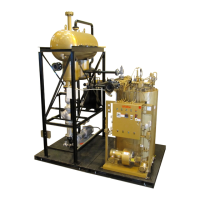
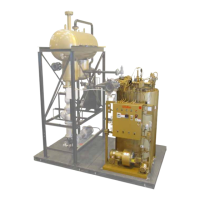
FT-C Vertical Electric Thermal Fluid Heater Manual 12 2013 ISSUE 1
Adhere to the following for gas supply installation:
1) Install gas piping in accordance with all applicable codes.
2) Ensure pipe and ttings used are new and free of dirt or other deposits.
3) Ensure piping is of the proper size for adequate gas supply to the gas head assembly. Consult
your gas company for specic recommendations.
4) When making gas piping joints, use a sealing compound resistant to the action of liqueed
petroleum gases. Do not use Teon tape on gas line heads.
5) Ensure no piping stresses are transmitted to the equipment. The equipment shall not be used
as a pipe anchor.
6) Ensure all vent connections on diaphragms, gas valves, pressure regulators, and pressure
switches (gas-red units) are vented per local code.
7) On gas-red units with NFPA valve trains, ensure the vent valve is piped to atmosphere per
local code. See Figure 4.
8) During any pressure testing of the system at pressures in excess of 34 mbar (0.5psi),
disconnect the heater at the heater manual shutoff valve (located at the end of the supplied gas
train) from the gas supply piping system.
9) Ensure the supply pressure is regulated by a non-stacking, tight, shutoff regulator.
10) Arrange gas piping so that it does not interfere with any cover or burner, inhibit service or
maintenance, or prevent access between unit and walls or another unit.The burner assembly
and gas controls terminate at a manual stop valve to which the gas supply should be
connected. Piping must be sized for a gas ow consistent with the required kW input. Large
pressure drops must be avoided. Fulton recommends that the supply piping between the
pressure regulator and the inlet to the heater be kept to a minimum. The minimum required gas
pressure at the stop valve varies with the model of heater. The requirements for natural
gas-red coil design models are as follows:
• Models FT-0080-C to FT-0400-C 34 mbar (0.5 psi)
• Models FT-0600-C to FT-0800-C 149 mbar (2.2psi)
• Models FT-1000-C to FT-1400-C 299 mbar (4.3psi)
Low emissions burners for all models require 345 mbar (5psi).
Even when the unit is shut down, the gas supply pressure must never exceed these values.
When operating, the supply pressure must not drop below these limits: Not less than 27 mbar where 34
mbar is required. Not less than 125 mbar where 149 mbar is required. Not less than 249 mbar where 299 mbar
is required.
11) After gas piping is completed and before wiring installation is started, carefully check
all piping connections, (factory and eld), for gas leaks. Use a soap and water solution.



 To Next Page