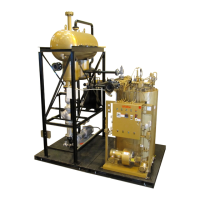
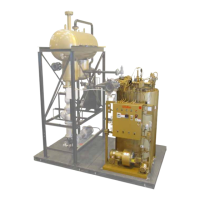
FT-C Vertical Electric Thermal Fluid Heater Manual 12 2013 ISSUE 1
a) The selection of the thermal uid most suited to your application is very important. Factors to
be considered include efciency, thermal stability, and adaptability to various systems, and
physical properties, including vapour pressure, freezing point, and ash and re points.
b) Heat transfer uids of both mineral and synthetic origin have been specially developed to
give thermal stability over a very wide range of temperature. A wide variety of thermal uids
have been used successfully in Fulton Thermal Fluid Heater systems, however, your nal
selection should be made in conjunction with Fulton Ltd. or the uid manufacturer.
c) The safe control and monitoring of the thermal uid temperature is of paramount importance.
d) The safe maximum bulk temperature of the uid must be strictly adhered to. The safe
maximum temperature of the uid varies, but a typical maximum for many types of mineral
oil based uids is 320°C.
e) Special care must be taken when consulting uid manufacturers’ literature, as maximum
uid temperatures quoted are the actual limit to which any of the uids may be subjected. It
is important to remember that in any red heater there exists a “lm temperature” which is
higher than the temperature of the “bulk” of the uid.
f) It is the BULK uid temperature and NOT the FILM temperature that is indicated by the
instruments.
g) As a general guide, the following list of uids that have given satisfactory service over many
years is provided.
h) This is by no means a complete list. Any uid specically designed for heat transfer use may
be considered; multipurpose oils are not acceptable.
1. AMOCO Transfer Oil 4199
2. CHEVRON Teknifax
3. DOW Dowtherm A or G
4. EXXON Caloria HT 43
5. MOBIL Mobiltherm 603 or 605
6. MULTITHERM PG1, IG4, IG1
7. PARATHERM Paratherm NF or HE
8. PETROCANADA CalFlo, AF, Purity FG,
CalFlo LT
9. TEXACO Texatherm
j) Any uid specically designed for heat transfer use must also exhibit these characteristics:
1. Be a stable and homogenous liquid to a temperature of at least 38°C over and above
the maximum intended temperature of utilisation, compatible with metals used in the
installation, and tolerating contact with atmospheric air.
2. The absence of any solid matter in suspension.
3. Non-toxic in the case of leakage.



 To Next Page