Chapter 7 -- Stability in Potentiostat Mode--Improving Potentiostat Stability
7 - 2
Improving Potentiostat Stability
There are a number of things that you can do to improve an unstable or marginally stable Interface 1000
potentiostat/cell system. This list is not in any particular order. Any or all of these steps may help.
• Slow down the potentiostat. The Interface 1000 has five control amplifier speed settings, which can be
selected in software. Slower settings are generally more stable.
• Increase the Interface 1000 I/E stability setting. The Interface 1000 includes three capacitors that can
be paralleled with its I/E converter resistors. These capacitors are connected to relays that are under
software control. Contact your local Gamry Instruments representative for more information
concerning changes in these settings.
• Lower the reference electrode impedance. Make sure that you don't have a clogged reference
electrode junction. Avoid asbestos fiber reference electrodes and double-junction electrodes. Avoid
small diameter Luggin capillaries. If you do have a Luggin capillary, make sure that the capillary’s
contents are as conductive as possible.
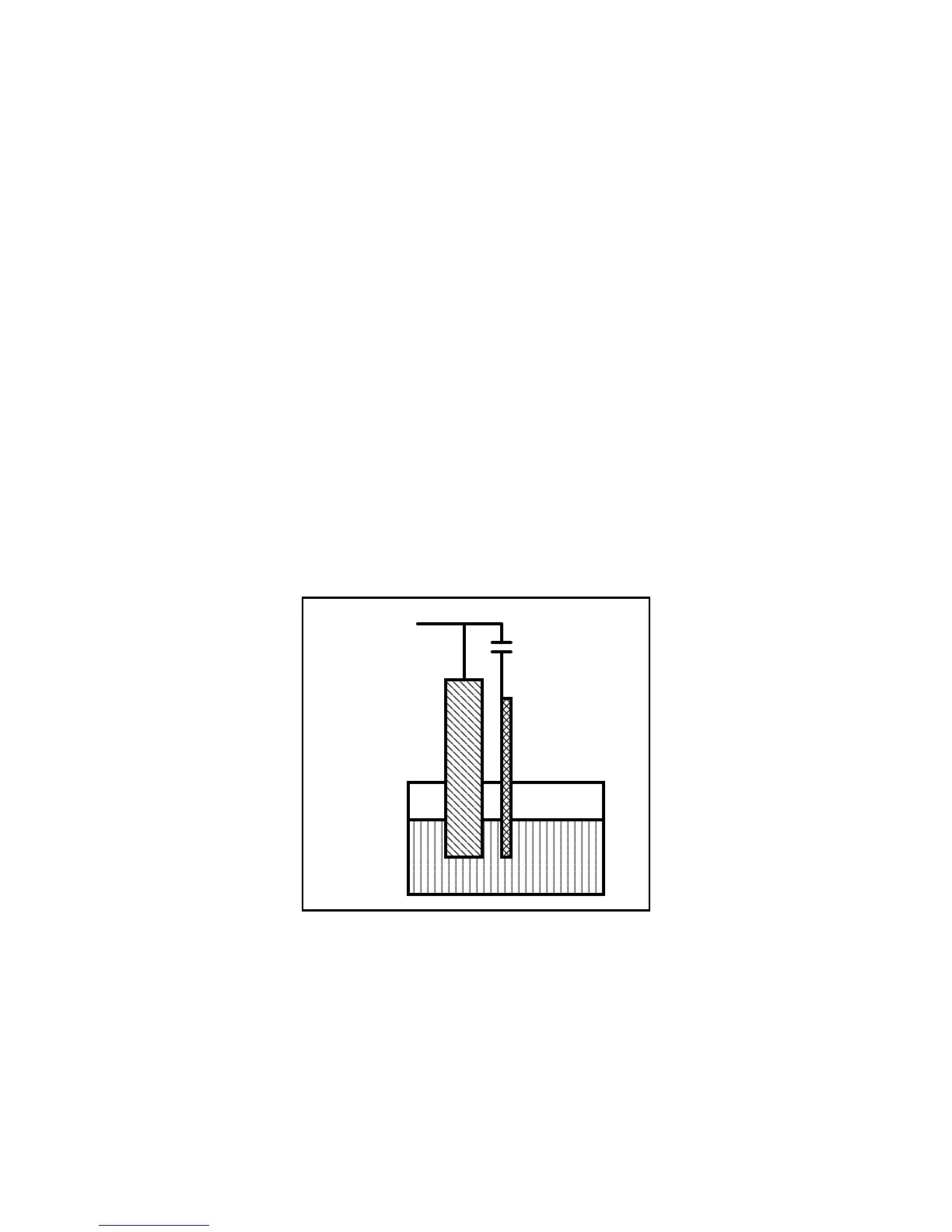
• Add a capacitively coupled low impedance reference element in parallel with your existing reference
electrode. The classic fast combination reference electrode is a platinum wire and a junction isolated
SCE. See Figure 7-1. The capacitor insures that DC potential comes from the SCE and AC potential
from the platinum wire. The capacitor value is generally determined by trial and error.
Figure 7-1
Fast Combination Reference Electrode
SCE Platinum
White
Cell Lead
100 pF to 10 nF
Electrolyte



 To Next Page