Chapter 8 -- Measurement of Small Signals--Hints for System and Cell Design
8 - 6
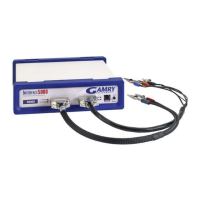
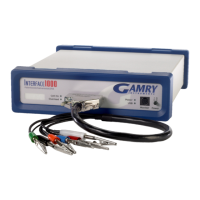
We do not recommend that you use the Interface 1000 with any cables not supplied by Gamry
Instruments. The Interface 1000 cable is not a simple cable like a typical computer cable. The Interface
1000 cable includes a number of individually shielded wires contained within an overall shield. We pay
careful attention to issues such as shield isolation, isolation resistance, and capacitance.
If you do need a special cable, contact us with your requirements.
Lead Placement
Many experiments with the Interface 1000 involve cells with small capacitances, the value of which may be
important.
In these cases, the capacitance between the Interface 1000 cell leads can result in an error. The Interface
1000 alligator clips can have 10 pF or more of mutual capacitance if they are run alongside each other.
If you wish to avoid excessive capacitance:
• Place the leads as far apart as possible. Pay special attention to physical separation between
the working electrode/ working sense leads and the counter/ counter sense/ reference
electrode leads.
• Have the leads approach the cell from different directions.
• Remove the alligator clips from the leads. In extreme cases you can replace the banana plugs
and pin jack with smaller connectors. If you do so, be careful not to compromise the isolation
between the center conductor and the shield.
The cell leads must not be moved during an experiment measuring small currents. Both microphonic and
triboelectric effects can create spurious results when the cell cables are moved.
Cell Construction
If you need to measure small currents or high impedances, make sure that your cell construction does not
limit your response.
A cell where the resistance between the electrodes is only 10
10
ohms cannot be used to measure 10
13
ohm impedances. In general, glass and Teflon are the preferred cell construction materials. Even glass may
be a problem when it is wet.
You also must worry about C
shunt
. Make the "inactive" portion of your electrodes as small as possible.
Avoid placing electrodes close together or parallel with each other if you are measuring high impedances.
Reference Electrode
Keep your reference electrode impedance as low as possible. High impedance reference electrodes can
cause potentiostat instability and excessive voltage noise pickup.
Try to avoid:
• Narrow bore or Vycor tipped Luggin capillaries.
• Poorly conductive solutions - especially in Luggin capillaries.
• Asbestos thread and double junction reference electrodes.
Reference electrodes often develop high impedances as they see use. Anything that can clog the isolation
frit can raise the electrode impedance. Avoid using saturated KCl based references in perchlorate ion
solutions
Instrument Settings
There are several things to remember in setting up a very sensitive experiment.
• In EIS, use the largest practical excitation. Don't use a 10 mV excitation on a coated specimen
that can handle 100 mV without damage.


 To Next Page