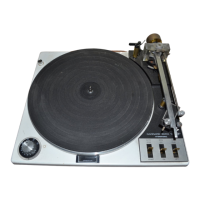
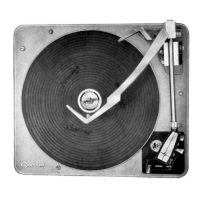
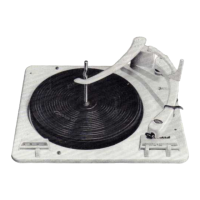
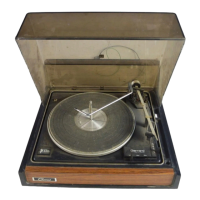
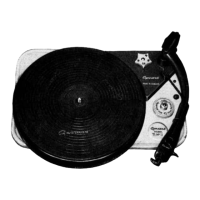
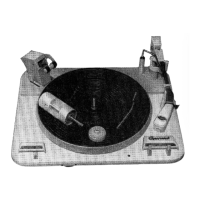
The Garrard Zero 100c is an automatic transcription turntable designed for high-fidelity audio playback. It supports both manual and automatic operation, capable of playing single records or stacks of up to six 12-inch records, with the number depending on record thickness. Adaptors are available for records with large center holes and for playing stacks of 7-inch records.
Function Description:
The Zero 100c is a two-speed transcription turntable featuring an ingenious tonearm designed to operate virtually without tracking error, incorporating a damped cueing action for gentle stylus placement. It includes an automatic record counter, a novel feature that tracks the number of L.P. records played to indicate when the diamond-tipped stylus should be checked for wear. The tonearm also boasts a magnetic anti-skating system, calibrated for both conical (spherical) and elliptical cartridge styli, which counteracts the inward skating force created as the record revolves, minimizing wear and sound distortion. A unique motor combines the advantages of both induction and synchronous motors, providing strong starting torque and constant running speed. The unit also features a record speed and pitch control system with a built-in stroboscopic checker for precise speed adjustment. A tilting device allows the cartridge tracking angle to be set correctly for either single record play or for automatic play of a stack of three records. The tonearm is lifted and lowered gently by a viscous damping mechanism.
Important Technical Specifications:
- Power Supply Voltage: 110/125V AC or 110/120 and 220/240V AC, depending on motor coil windings. Power supply requirements are indicated on the motor.
- Power Supply Frequency: 50 or 60Hz, dependent on the interchangeable motor pulley and stroboscopic turntable fitted.
- Power Consumption: Approximately 9 watts.
- Speeds: 33⅓ and 45 rev/min, with a variation of plus or minus 3%. Speed accuracy is checked via an illuminated stroboscope.
- Motor: 4-pole induction rotor section for starting torque and a synchronous section for constant running speed, resiliently mounted.
- Tonearm (Pickup Arm): The tonearm head pivots laterally to maintain negligible tracking error.
- Size: Approximately 14¾ inches (375mm) wide, 13¼ inches (335mm) deep, and 6¾ inches (170mm) high.
- Weight: Approximately 11½ lbs (5.2kg).
Usage Features:
- Installation: The unit is secured to a mounting board using transit screws and clips, which must be adjusted for playing position. Power supply, ground, and phono leads are threaded through a cutout in the mounting board, ensuring they are clear of moving parts.
- Cabling: RCA-type output connectors are used. Instructions are provided for connecting a stereo cartridge to a stereo amplifier, a mono cartridge to a stereo amplifier (using a 'Y' adaptor if needed), and a stereo cartridge to a mono amplifier (also using a 'Y' adaptor).
- Cartridge Fitting: The unit comes with a kit of cartridge fixing parts, including screws of different lengths and a clear plastic setting gauge. The cartridge carrier is removed, the cartridge is attached and aligned using the gauge, leads are connected (following a specified color code for right/left channel signal and ground), and the carrier is refitted.
- Stylus Force Setting: The counterbalance weight is screwed onto the tonearm's rear extension. The stylus force weight is adjusted to the recommended setting (up to 3 grammes) by the cartridge manufacturer, with the tonearm balanced at 0 before setting.
- Anti-Skating Device: This magnetic system is calibrated for both conical and elliptical stylus tips. The magnetic shield is moved along the transparent tonearm mounting bracket to align with the 'conical' or 'elliptical' scale corresponding to the set stylus force.
- Record Playback (Manual): A short single record spindle is fitted, the record is placed, speed (33⅓ or 45 rev/min) and cartridge tilting lever (M) are set, and the manual operating control tab is moved to ON. The tonearm can be lowered manually or using the cueing control tab.
- Record Playback (Automatic): A long automatic record spindle is fitted. For 12-inch records, up to six records are loaded onto the spindle step, resting on the record platform. For 7-inch records with large center holes, an optional LRS100 spindle is used. For 7-inch records with small center holes, a Garrard Type A6 record platform adaptor is used. The speed and size selector are set, the cartridge tilting lever is set to A (for automatic play), and the automatic operating control tab is moved to START and held briefly.
- Controls:
- Cue and Pause: The cue control tab lifts the tonearm during play for repeating or passing over music, or for temporary pause.
- Repeat: Moving the automatic control tab to START before the end of a record replays a single record or the last record of a stack.
- Reject: Moving the automatic control tab to START rejects any record in a stack (except the last). Moving it to STOP rejects a single record or the last of a stack.
- Stop: Moving the automatic control tab to STOP during play returns the tonearm to its rest and switches off the unit. For stacks, it lowers the next record before switching off.
- Automatic Record Counter: This counter registers each time the tonearm returns to its rest, moving a red pointer up a scale. The scale is quartered (400, 800, 1200 cycles) and further subdivided by red marks (100 cycles each). It serves as a reminder to check stylus condition, not as an indicator for stylus replacement. The counter can be set to zero by supporting the tonearm over the platter and turning the ratchet wheel counterclockwise.
Maintenance Features:
- Stylus Care: Keep the cartridge stylus clean and replace it when worn.
- Record Care: Store and clean records as recommended by manufacturers; avoid leaving records on the turntable for long periods.
- Platter Removal: The record spindle is pulled out, the rubber mat and plastic center disc are removed, and the wire retaining clip is pulled off to lift the platter.
- Lubrication: The bearings of the intermediate wheel, motor, and platter are oil-retaining and rarely require lubrication. When needed, a light oil (like sewing machine oil) is applied to the platter bearing, platter spindle bearings, intermediate wheel bearing, and motor bearing. Care must be taken to avoid oil contact with driving surfaces.
- Cleaning: The platter mat can be cleaned with a soft brush. The cartridge stylus should be cleaned by periodically removing the carrier and blowing off dust or gently brushing with a soft brush. The driving surfaces of the motor pulley, intermediate wheel, and platter rim can be wiped with a lint-free cloth. Stroboscopic markings can also be wiped clean.
- Troubleshooting: A service hints section provides common symptoms (e.g., unit fails to start, speed variation, no sound, distorted sound, tonearm issues), probable causes, and remedies.
- Adjustments:
- Tonearm Lowering Position: A small screwdriver adjusts screw A to move the lowering position inward or outward, ensuring the stylus lands inside the groove guard.
- Tonearm Lifting Height: Adjusting screw B increases or reduces the lifting height, aiming for the finger lift to be 1⅞ inches (46mm) above the record surface.
- Tonearm Lifting Height Restriction: Adjusting screw C restricts the tonearm from rising more than 1/16 inch (1.5mm) higher than the set lifting height.
- Spare Parts and Service: A list of selected spare parts is provided with part numbers. Instructions are given for ordering parts and contacting service departments in the UK and USA.
- Motor Pulley Fitting: Detailed instructions are provided for removing the old motor pulley (using a 4 B.A. screw as an extractor) and fitting a new one, including applying gentle heat if necessary. If the power supply frequency changes, a new stroboscopic platter ring must also be fitted, ensuring it is aligned correctly.

 Need help?

 To Next Page

 General