Appendix B - Settings and Signals
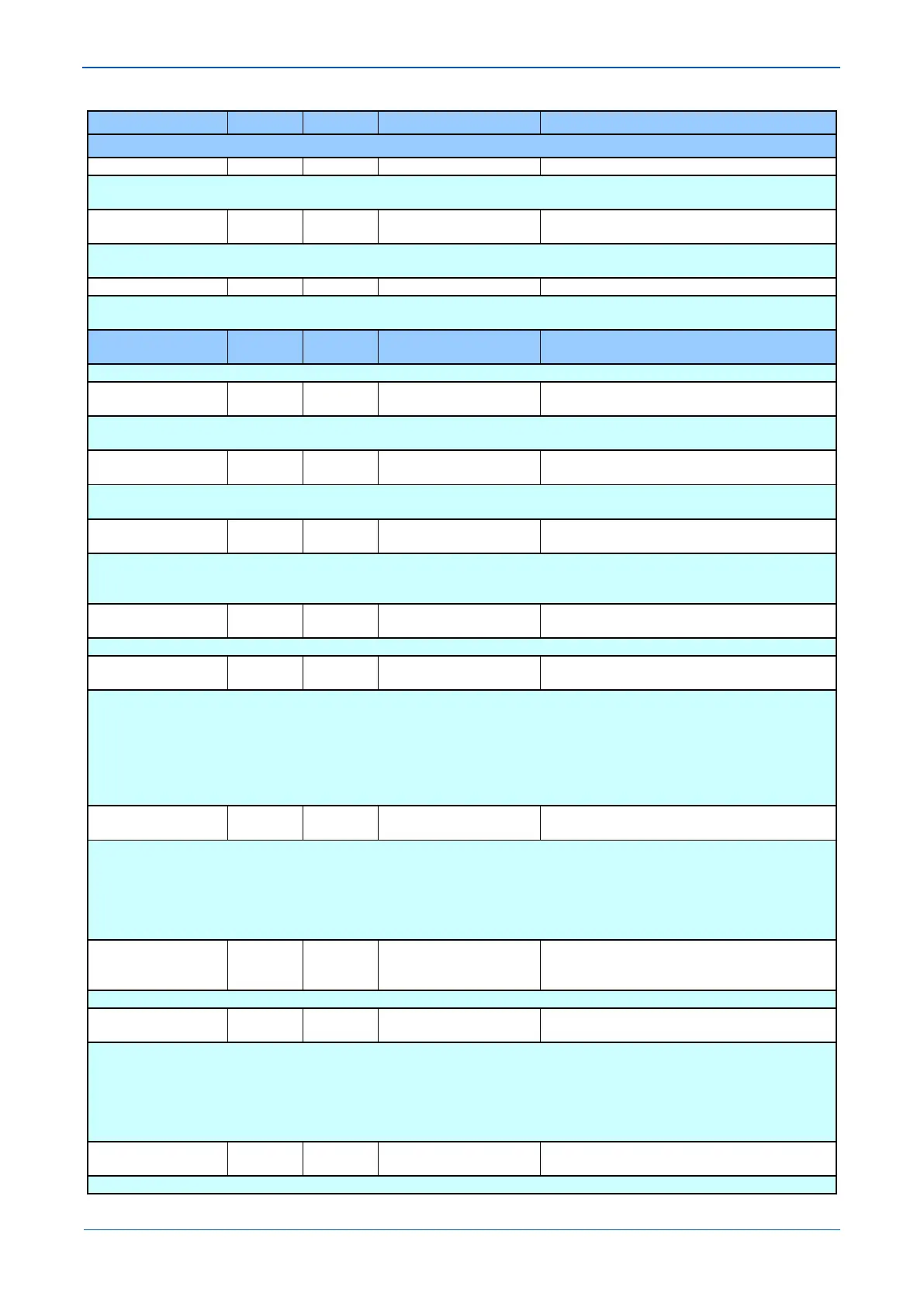
MENU TEXT COL ROW DEFAULT SETTING AVAILABLE OPTIONS
DESCRIPTION
Text label to describe each individual control input. This text is displayed when a control input is accessed by the hotkey menu. It is displayed
in the programmable scheme logic description of the control input
Control Input 30 29 1E Control Input 30
From 32 to 163 in steps of 1
[ASCII Text (16 chars)]
Text label to describe each individual control input. This text is displayed when a control input is accessed by the hotkey menu. It is displayed
in the programmable scheme logic description of the control input
Text label to describe each individual control input. This text is displayed when a control input is accessed by the hotkey menu. It is displayed
in the programmable scheme logic description of the control input
30 00
This column contains settings for Line Parameters
Line Length 30 01 100000
From 300 to 1000000 in steps of 10
[Courier Number (metres)]
Setting of the protected line/cable length in km. This setting is available if MEASURE’T SETUP column is selected as Visible in the
CONFIGURATION column and if Distance unit in the MEASURE’T SETUP column is selected as kilometres
Line Length 30 02 62.1
From 0.05 to 621 in steps of 0.005
[Courier Number (miles)]
Setting of the protected line/cable length in miles. This setting is available if Distance unit in the MEASURE’T SETUP column is selected as
miles. Dual step size is provided, for cables/short lines up to 10 miles the step size is 0.005 miles, 0.01 miles otherwise
Line Impedance 30 03 10
From 0.05*v1/I1 to 500*V1/I1 in steps of 0.01*V1/I1
[Courier Number (impedance)]
Setting for protected line/cable positive sequence impedance in either primary or secondary terms, depending on the Setting Values
reference chosen in the CONFIGURATION column. The set value is used for Fault locator, and for all distance zone reaches calculation if
‘Simple’ setting mode under GROUP x DISTANCE SETUP is selected.
Line Angle 30 04 70
From 20 to 90 in steps of 1
[Courier Number (angle)]
Setting of the line angle (line positive sequence impedance angle).
kZN Res Comp 30 05 1
From 0 to 10 in steps of 0.01
[Courier Number]
Setting of the residual compensation factor magnitude, used to extend the ground loop reach by a multiplication factor of (1+ kZN), is
calculated as ratio:
│kZN│ = (Z0 – Z1)/3Z1 where,
Z1 = positive sequence impedance for the protected line or cable.
Z0 = zero sequence impedance for the protected line or cable.
This setting is a used for Distance protection (when set to simple mode) . If Distance protection is set to Advanced mode, there are individual
settings per Zone in the GROUP x DISTANCE ELEMENTS settings.
kZN Res Angle 30 06 0
From -180 to 90 in steps of 1
[Courier Number (angle)]
Setting of the residual compensation factor angle (in degrees) is calculated as:
ÐkZN = Ð (Z0 – Z1)/3Z1 where,
Z1 = positive sequence impedance for the protected line or cable.
Z0 = zero sequence impedance for the protected line or cable.
This setting is a used for Distance protection (when set to simple mode) . If Distance protection is set to Advanced mode, there are individual
settings per Zone in the GROUP x DISTANCE ELEMENTS settings.
Mutual Comp 30 07 Disabled
Enabled
To enable (activate) or disable (turn off) the Mutual compensation replica used in both, Distance and Fault locator ground fault loops.
KZm Mutual Set. 30 08 1
From 0 to 10 in steps of 0.01
[Courier Number]
Setting of the mutual compensation factor kZm magnitude is calculated as a ratio:
|kZm| = ZM0/3Z1 where,
ZM0 = zero sequence mutual impedance for the protected line or cable.
Z1 = positive sequence impedance for the protected line or cable.
Setting kZm is visible if ‘Mutual Comp’ is enabled. This setting is a used for fault locator and Distance protection (when set to simple mode) .
If Distance protection is set to Advanced mode, there are individual settings per Zone in the GROUP x DISTANCE ELEMENTS settings.
KZm Mutual Angle 30 09 0
From -180 to 90 in steps of 1
[Courier Number (angle)]
Setting of the mutual compensation angle (in degrees) is calculated as:



 To Next Page