10
Issue: 8 (Applies to firmware 2387 6.09 onwards)
Document number: 1390-PS-0039
4.2. Installation
Do NOT remove the black “rubber” transducer caps. Warranty is void if the green security seal is damaged or
removed.
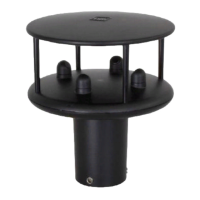
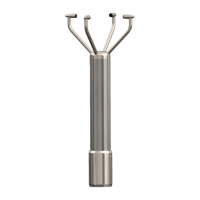
Take care not to knock the four Transducer arms. All the time the WindObserver 65 is not in its final location, it
should be protected from damage by keeping it in the original packaging as long as possible, treating it as a
delicate instrument.
If an Intrinsically Safe (IS) device is required, the I.S. WindObserver must be used - the WindObserver 65 is NOT
an IS device.
Warranty is void if the unit case is removed.
When selecting a site three attributes need to be considered:
• Physical location and obstructions
• Distance from the power supply and data collection system
• EMC interference
4.3. Installation Guidelines
The WindObserver 65 has been designed to meet and exceed the stringent standards listed in its specification.
Operating in diverse environments all over the world, WindObserver 65 requires no calibration or adjustment
whatsoever.
As with any sophisticated electronics, good engineering practice should be followed to ensure correct operation.
Always check the installation to ensure the WindObserver 65 is not affected by other equipment operating
locally, which may not conform to current standards, e.g., radio/radar transmitters, boat engines, generators etc.
Guidelines –
Avoid mounting in the plane of any radar scanner – a vertical separation of at least 2m should be achieved.
Radio transmitting antennas, the following minimum separations (all round) are suggested
• VHF IMM – 1m
• MF/HF – 5m
• Satcom – 5m (avoid likely lines of sight)
Ensure the product is correctly earthed in accordance with this manual
Use cables recommended by Gill, keeping the length below the maximum allowed (
See Section 4.5
) Where the
cables are cut and re-connected (junction boxes, plugs and sockets) the cable screen integrity must be
maintained, to prevent the EMC performance being compromised.
Earth loops should not be created – earth the system in accordance with the installation guidelines.
(
See Connections Appendix C )
Ensure the power supply operates to the WindObserver 65 specification at all times.
Avoid turbulence caused by surrounding structures that will affect the accuracy of the WindObserver 65 such as trees,
masts and buildings. The World Meteorological Organisation makes the following recommendation:
The standard exposure of wind instruments over level open terrain is 10m above the ground. Open terrain is
defined as an area where the distance between the sensor and any obstruction is at least 10 times the height of
the obstruction.
When installing the unit degrease the unit and hold with lint free gloves to reduce the build-up of deposits.


 To Next Page