11
Issue: 8 (Applies to firmware 2387 6.09 onwards)
Document number: 1390-PS-0039
4.4. Bench system test
Prior to physically mounting the WindObserver 65 in its final location, we strongly
recommend that a bench system test be carried out to confirm the system is configured
correctly, is fully functional and electrically compatible with the selected host system and
cabling (preferably utilising the final cable length). The required data format, units, output rate,
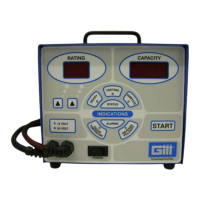
and other options should also all be configured at this stage. If an Integrity Check Chamber
(ICC) has been purchased refer to Section 10.6.
4.5. Cabling
A RS422 compatible cable should be used, with the number of twisted pairs matching the application.
Generic description – Twisted pairs with drain wire, screened with aluminised tape,
with an overall PVC sheath. E.g., wire size 7/0.2mm (24 AWG).
The table shows some suitable manufacturers’ references; other manufacture’s equivalents can be used.
Table 1
No. of Pairs Gill ref.
Belden
ref.
Batt electronics ref.
Gauge
2 - 9729 91071
3 026-02660 9730 91030
4 026-03156 9728 91199
6 - 8778 91011
9 026-02663 8774 91009
Cable length
The typical maximum length at 9600 baud is 1km (3200ft), using the recommended cable. If any problems of data
corruption are experienced (due to, for example, a high local electrical ‘noise’ level), then a lower baud rate should be
used. Alternatively, a thicker or higher specification cable can be tried. If a heated unit is used on longer cables than
supplied, consideration should be given to powering the heater using lower gauge wire or paralleling wires to reduce
volt drops.


 To Next Page