Application
Methods
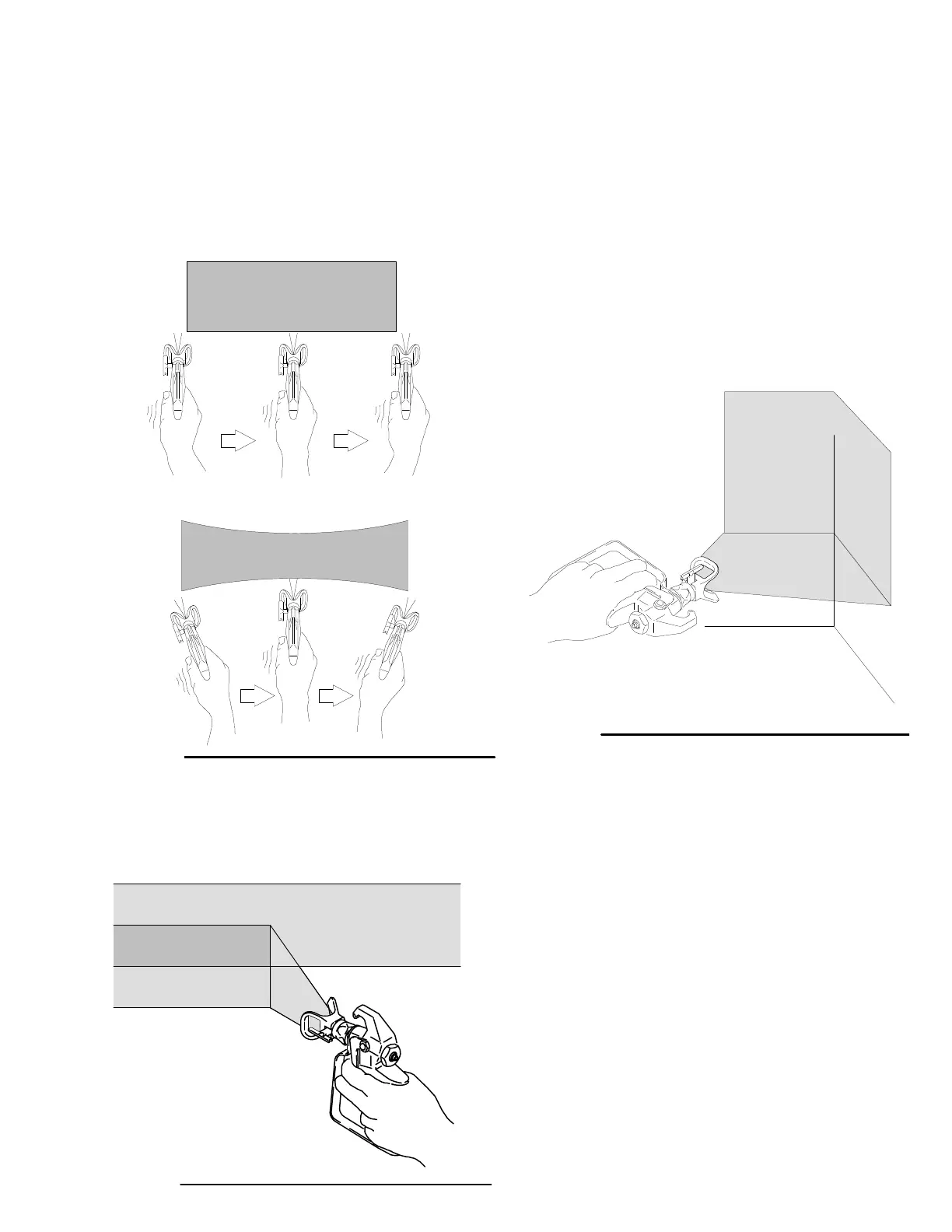
Always hold the gun perpendicular to the surface and
keep
the gun at an even to 300–356 mm from the surface
you
are spraying. See Fig. 10.
Begin
moving the gun in a horizontal direction at a steady
rate.
Start the spray stroke of
f the target surface and pull
the trigger as the gun is moving. Then, while the gun is
still
moving, and as you approach the other edge, release
the trigger. This method avoids excess paint buildup at
the
end of each stroke.
0277
Fig. 10
The
correct speed for moving the gun will allow a full, wet
coating
to be applied without runs or
sags. Lapping each
stroke 50% over the previous stroke produces uniform
paint thickness. And spraying in a uniform pattern alter-
nately
from right to left,
then left to right, provides a pro
-
fessional
finish. See Fig. 1
1.
0487
Fig. 11
The best way to control the rate of coverage is with the
gun tip size. A small tip orifice applies less paint and a
narrower pattern. A larger tip orifice applies more paint
and
a wider pattern.
Do not try to increase coverage by increasing the fluid
pressure!
Using the lowest
pressure necessary to get the
desired results will help prolong the life of your sprayer
and
minimize paint lost by over–spray
.
For interior corners,
such as on a bookcase or inside
a
cabinet, aim the gun toward the center of the corner to
spray. By dividing the spray pattern this way, the edges
on
both sides are sprayed evenly
. See Fig. 12.
048
Fig. 12
If there is
a wind,
angle the spray pattern into the wind
to minimize drifting. Paint from the ground to the roof.
Shrubs.
When next to the house, tie back shrubs from
the
surface to be painted with rope and stakes. Then
cov
-
er them with a canvas drop cloth as the painter ap-
proaches the area. Remove the canvas drop cloth as
soon
as the area is painted, to prevent possible damage
to
the shrubs.
Concrete
walks.
If the walkways will be walked on, cov
-
er
them with a canvas drop cloth to avoid slipping.
Other
-
wise
a plastic drop cloth is all that is needed.
Electrical outlets and lamps.
Protect electrical outlets
with masking tape. Cover lamps with plastic bags se-
cured
with masking tape.
Nearby
objects.
Move objects such
as automobiles, pic
-
nic
tables, lawn furniture, etc. upwind of the surface to
be
sprayed.
In the case of a nearby home, make a
protective
barrier
by hanging plastic between two long poles. 4




 To Next Page