EasyManua.ls Logo

Grizzly G9983 - User Manual

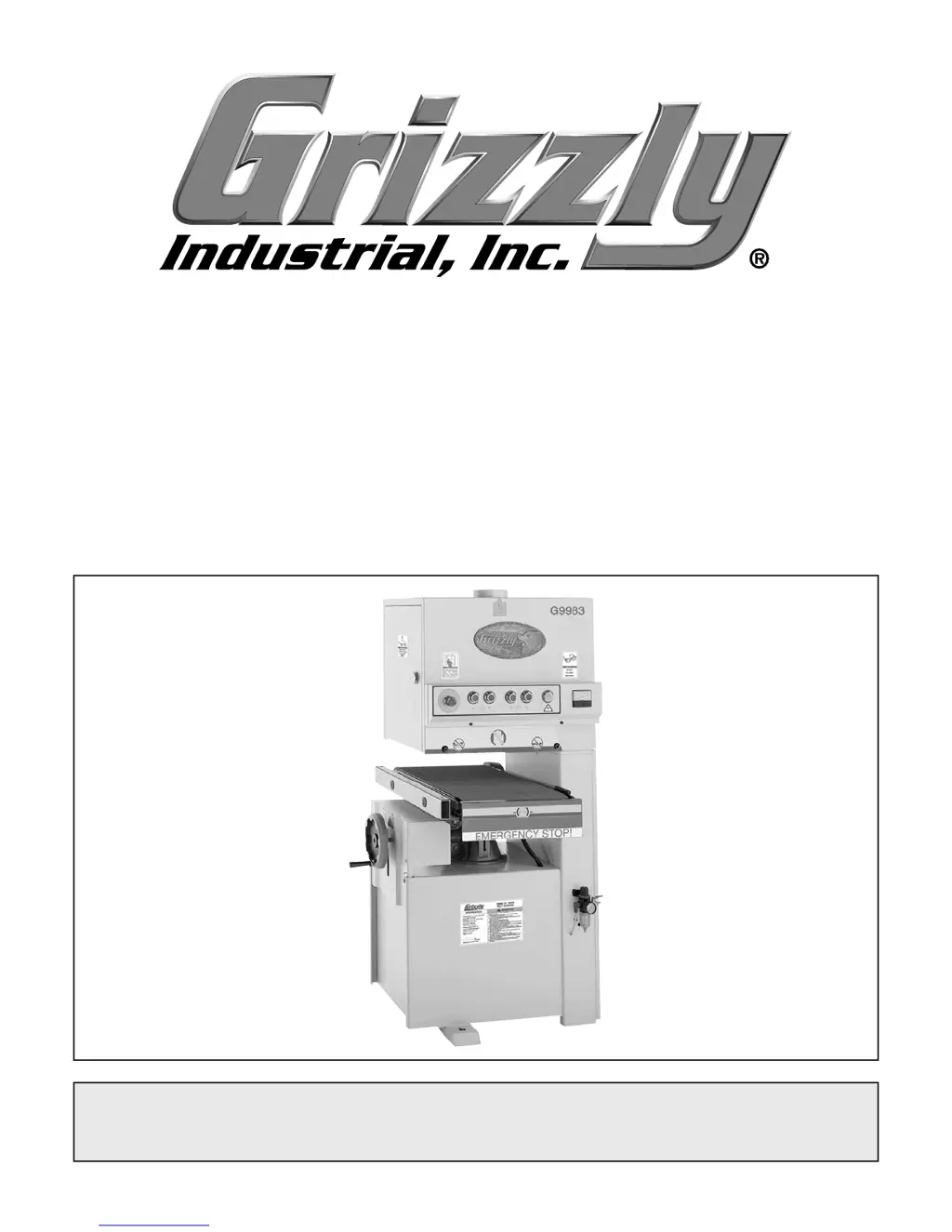
Grizzly G9983
60 pages
Print Icon
To Next Page IconTo Next Page
Loading...
COPYRIGHT © OCTOBER, 2002 BY GRIZZLY INDUSTRIAL, INC., REVISED JUNE, 2013 (TS)
WARNING: NO PORTION OF THIS MANUAL MAY BE REPRODUCED IN ANY SHAPE
OR FORM WITHOUT THE WRITTEN APPROVAL OF GRIZZLY INDUSTRIAL, INC.
#TR4202 PRINTED IN TAIWAN
MODEL G9983
15" OPEN-END
WIDE-BELT SANDER
OWNER'S MANUAL
(For models manufactured since 8/09)

Table of Contents

Other manuals for Grizzly G9983

Questions and Answers

  • K
    Kimberly WestSep 23, 2025
    Why does my Grizzly Sander make a grinding noise when braking?
    • R
      Richard BentonSep 23, 2025
      A grinding noise when braking with your Grizzly Sander indicates that the brakes are severely worn out. Replace the brake pads and have the rotor turned or possibly replaced.
  • T
    Toni MartinezSep 23, 2025
    Why am I getting poor, non-aggressive sanding results with my Grizzly Sander?
    • K
      Kelly LeSep 23, 2025
      Poor, non-aggressive sanding results with your Grizzly Sander may be due to: * The platen being adjusted incorrectly, above the bottom surface level of the lower sanding rollers. Adjust the platen on the same plane as, or lower than, the bottom surface level of the lower rollers. * The sanding belt being loaded with sawdust. Clean the sanding belt to unload the sawdust. * The sanding belt being worn out. Replace the sanding belt with a new one.
  • S
    Seth TaylorSep 23, 2025
    What to do if my Grizzly Sander conveyor belt is not tracking in the center?
    • A
      ayalajamieSep 23, 2025
      If the conveyor belt on your Grizzly Sander is not tracking in the center, it is likely that the conveyor rollers have moved out of adjustment. Re-adjust the conveyor rollers.
  • G
    Gary RhodesAug 31, 2025
    Why are there glossy spots or streaks on my workpiece after sanding with my Grizzly Sander?
    • M
      Marc KnightAug 31, 2025
      Glossy spots or streaks on your workpiece after sanding with your Grizzly Sander can be caused by a worn sanding belt; replace it. Another cause could be a rear pressure roller set too low; raise it.
  • D
    davidthomasAug 25, 2025
    Why does my Grizzly Sander motor overheat?
    • J
      James MoodyAug 25, 2025
      Your Grizzly Sander motor may overheat due to several reasons. The motor could be overloaded, so reduce the load. Air circulation might be restricted, so clean the motor. There could be a short circuit in the motor or loose connections, so inspect the connections. Low voltage or incorrect fuses/circuit breakers could also be the cause; correct the voltage or install the correct fuses/breakers.
  • A
    adamsmarioAug 25, 2025
    What to do if my Grizzly G9983 Sander slows down during operation?
    • B
      brownjasonAug 26, 2025
      If your Grizzly Sander slows down while you're using it, the feed rate might be too high. Try feeding the workpiece slower and watch the load meter. Alternatively, the depth of cut may be too great; reduce it and monitor the load meter.
  • T
    turnergabrielAug 26, 2025
    How to prevent my Grizzly G9983 Sander belt from clogging too fast?
    • A
      amberbaileyAug 26, 2025
      If your sanding belt is clogging quickly, it could be that the sanding belt grit is too small for the job. Replace it with a coarser grit belt. Also, excessive depth of cut can cause clogging, so reduce it. Finally, if the wood is too moist, allow it to dry out before sanding.
  • A
    Ashley CoxAug 27, 2025
    Why is the workpiece slipping on the feed belt of my Grizzly G9983 Sander?
    • K
      Kaitlyn Rose DDSAug 27, 2025
      If the workpiece is slipping on the feed belt of your Grizzly Sander, the pressure rollers may be set too high; lower them. A dirty feed belt can also cause slipping, so clean it. If the feed belt is worn, replace it.
  • T
    Timothy RamosAug 27, 2025
    Why is my Grizzly Sander making a loud, repetitive noise?
    • E
      Erik SandersAug 27, 2025
      A loud, repetitious noise from your Grizzly Sander could be due to missing or loose pulley set screws or keys. Inspect the keys and set screws, replacing or tightening them if necessary. Another possibility is the motor fan hitting the cover; tighten the fan or shim the cover. Finally, the V-belt could be defective, so replace it.
  • E
    Erin SuarezAug 27, 2025
    Why isn't the sanding belt on my Grizzly Sander tensioning correctly?
    • W
      walkerbillyAug 28, 2025
      If the sanding belt on your Grizzly Sander isn't tensioning correctly and the rollers slip, check the air pressure. Adjust it to 75 PSI at the primary regulator. Also, inspect all hoses and connections for air leaks; use water on suspected areas to detect bubbles.

Summary

Introduction

Contact and Manual Information

Provides contact details for Grizzly Technical Support and Documentation Manager, and information on manual accuracy.

Machine Data Sheet

Operation and Drum Specifications

Details on sanding operation parameters like width, thickness, speed, and drum types and sizes.

Platen, Construction, and Other Specs

Information on platen type/size, construction materials, floor-to-table height, and other technical specifications.

Basic Controls and Features

External Features Identification

Identifies external components of the sander using labels from Figure 1.

Control Panel Overview

Details the main power switch, and ON/OFF buttons for the feed and sanding belts as shown in Figure 2.

Access Doors and Components

Left Access Door Components

Lists components found behind the left-hand access door, including limit switch and platen adjustment knob.

Right Access Door Components

Lists components found behind the right-hand access door, such as oscillating roller and air filter.

Section 1: Safety

General Safety Instructions

Provides critical safety instructions, defines safety symbols, and outlines general machinery safety guidelines.

Operational Safety Precautions

Operational Safety Guidelines

Details safe practices for machine operation, including apparel, tool use, and maintenance.

Health and Hazard Warnings

Addresses risks related to hazardous dust, hearing protection, and keeping children/bystanders away.

Wide-Belt Sander Safety

Wide-Belt Sander Specific Safety

Safety advice specific to wide-belt sanders, including kickback, feed rate, and entanglement.

Workpiece Handling and Machine Operation Safety

Guidance on workpiece quantity, inspection, power disconnect, and unattended machine operation.

Section 2: Power Supply

Power Availability and Circuit Requirements

Discusses the need for adequate power supply circuits and specific requirements for 220V operation.

Full-Load Current Rating

Specifies the full-load current draw of the machine and considerations for potential overload.

Electrical Connections and Grounding

Connection Type and Grounding

Details permanent hardwired connections and essential grounding instructions for safety.

Extension Cord Policy

States that extension cords cannot be used with this permanently connected machine.

Section 3: Setup

Unpacking, Inventory, and Setup Needs

Covers procedures for unpacking, checking inventory, and identifying necessary setup items.

Machine Cleanup and Site Considerations

Machine Cleanup Procedure

Step-by-step guide for removing rust preventative coating from the machine.

Site Considerations

Discusses weight load, space allocation, physical environment, electrical installation, and lighting.

Machine Mounting and Floor Bolting

Recommendations for mounting the machine and methods for bolting to concrete floors.

Assembly Procedures

Installing Handwheel Handle and Platen

Instructions for attaching the handwheel handle and inserting the platen into its housing.

Platen Adjustment and Air Hose Connection

Details on setting the platen even with belt rollers and connecting the air hose to the regulator.

Installing and Tensioning Sanding Belt

Steps for installing the sanding belt and adjusting its tension using the belt tension switch.

Pressure Roller Check and Dust Collection

Procedures for checking pressure roller height and setting up the dust collection system.

Power Connection, Disconnection, and Test Run

Covers connecting to power, disconnecting, and performing a test run of the machine.

Recommended Adjustments Checklist

A checklist of recommended adjustments to ensure optimal machine performance.

Section 4: Operations

Operation Overview and Safety

Provides an overview of machine operation and reiterates essential safety precautions.

Choosing Sandpaper and Conveyor Height

Guidance on selecting sandpaper grit and adjusting the conveyor belt height.

Feed Belt Speed and Load Meter Usage

Instructions for changing feed belt speed and interpreting the load meter.

Platen Depth Settings

Details the three basic platen positions and how to adjust them for different finishes.

Section 5: Accessories

Recommended Sanding Accessories

Lists and describes optional accessories like sanding pads, roller tables, sanding belts, and dust collectors.

Section 6: Maintenance

Maintenance Schedule and Cleaning

Outlines a maintenance schedule and procedures for cleaning the machine.

Lubrication and Filter Maintenance

Covers lubrication points and instructions for emptying regulator filters.

Section 7: Service

Troubleshooting Guide

Provides solutions for common symptoms and problems encountered with the machine.

Oscillation Timing Adjustment

Details how to adjust the oscillation timing for balanced side-to-side belt movement.

Oscillation Speed and Return Control

Instructions for controlling oscillation speed and adjusting the oscillation return.

Limit Switches and Pressure Roller Depth

Covers adjustment of limit switches and setting the pressure roller depth.

Pressure Roller Tension Adjustment

Guidance on adjusting pressure roller tension for proper workpiece feed.

Feed Belt Tension and Tracking

Procedures for adjusting feed belt tension and tracking.

V-Belt Tension and Replacement

Information on checking V-belt tension and procedures for replacing V-belts.

Platen Graphite and Air System Maintenance

Instructions for replacing the platen graphite sheet and maintaining the air system.

Replacing Brake Pads

Step-by-step guide for checking and replacing the brake pads and cleaning the rotor.

Section 8: Wiring

Wiring Safety Instructions

Crucial safety warnings and guidelines for working with the machine's electrical wiring.

Electrical Panel Wiring Diagram

Diagram showing the wiring connections within the main electrical panel.

Control Panel Wiring Diagram

Wiring diagram illustrating the connections for the machine's control panel.

Main Motor and Component Wiring

Wiring diagrams for the main motor and other electrical components.

Feed Belt Motor Wiring Diagram

Wiring diagram specific to the feed belt motor connections.

Main Motor Wiring Diagram

Detailed wiring diagram for the main motor assembly.

Section 9: Parts

Accessories Parts List

Lists part numbers and descriptions for optional accessories.

Base and Sanding Motor Parts List

Part numbers and descriptions for the machine's base and sanding motor components.

Conveyor Parts List

Lists part numbers and descriptions for the conveyor system components.

Sanding Belt Drive System Parts List

Part numbers and descriptions for the sanding belt drive system components.

Sanding Cabinet and Air System Parts List

Lists part numbers and descriptions for the sanding cabinet and air system components.

Electrical Cabinet Parts List

Part numbers and descriptions for the electrical cabinet components.

Machine Labels

Safety Labels Information

Information about machine labels, including safety labels and their importance.

Warranty and Returns

Grizzly G9983 Specifications

General IconGeneral
ModelG9983
Disc Diameter9"
Belt Size6" x 48"
Belt Speed1800 FPM
Motor1 HP, 110V/220V, Single-Phase
Voltage110V/220V
Disc Size9"
Table Tilt0-45 Degrees
Table Tilt (Disc)0-45 Degrees

Related product manuals