Pass/Refer Criteria for TEOAE
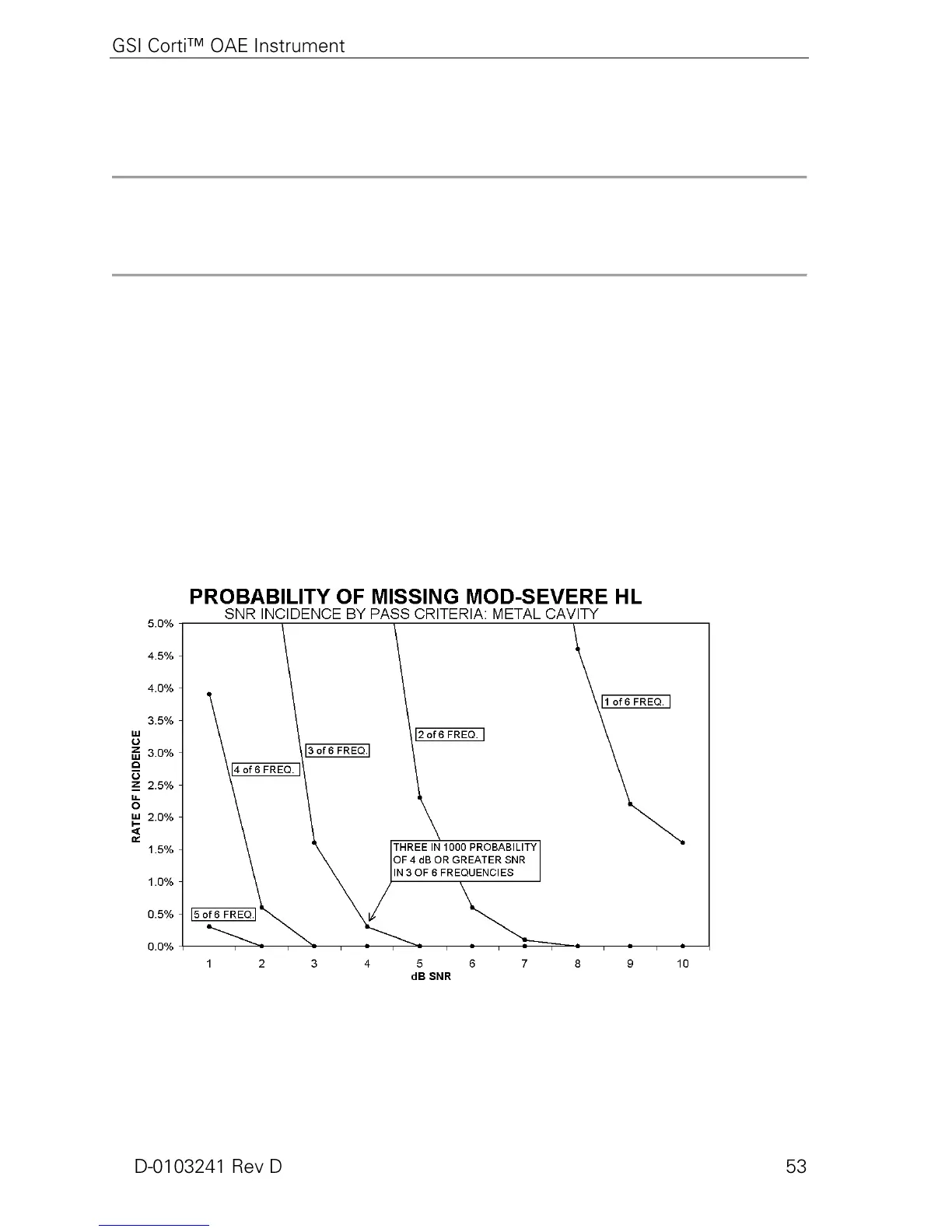
The same basic principles that underlie DPOAE Pass/Fail criteria underlie TEOAE Pass/Fail criteria.
In the case of transients, requiring SNR of 4 dB at any three out of the six test frequencies drops the
probability of passing an ear with a significant hearing loss to less than 1%.
NOTE: The SNR limits for transients are lower than the corresponding limits for distortion products
primarily because the traditional noise calculation used in TEOAE measurements (and in the Corti
instrument) gives a 3 dB lower SNR than the calculation used for DPOAEs. Without that difference,
the numerical SNR value for a PASS with the two methods would be quite similar.
The Corti uses a patented noise-rejection algorithm that permits accurate DPOAE and TEOAE
measurements in background noise and babble as high as 55 to 65 dB SPL (A-weighted). Briefly
explained, use of available memory in the Corti processor permits a post-hoc statistical analysis that
identifies those samples whose retention would improve the overall accuracy. Those samples are
included in the final analysis; the noisier samples are rejected.
The improved operation in noise with the new algorithm was so substantial that a complete replica of
the original validation tests in "fully impaired ear" cavities was conducted and it was verified that no
increase in false negatives (false passes) was introduced. Under no test conditions was any such
degradation uncovered.
The artifact rejection can only reject the noisiest samples in a measurement period. If the ambient noise
level rises too high (and/or the eartip seal is poor), then all samples will be noisy and accurate
measurements will be impossible, in which case the test result will indicate “noisy.”


 To Next Page